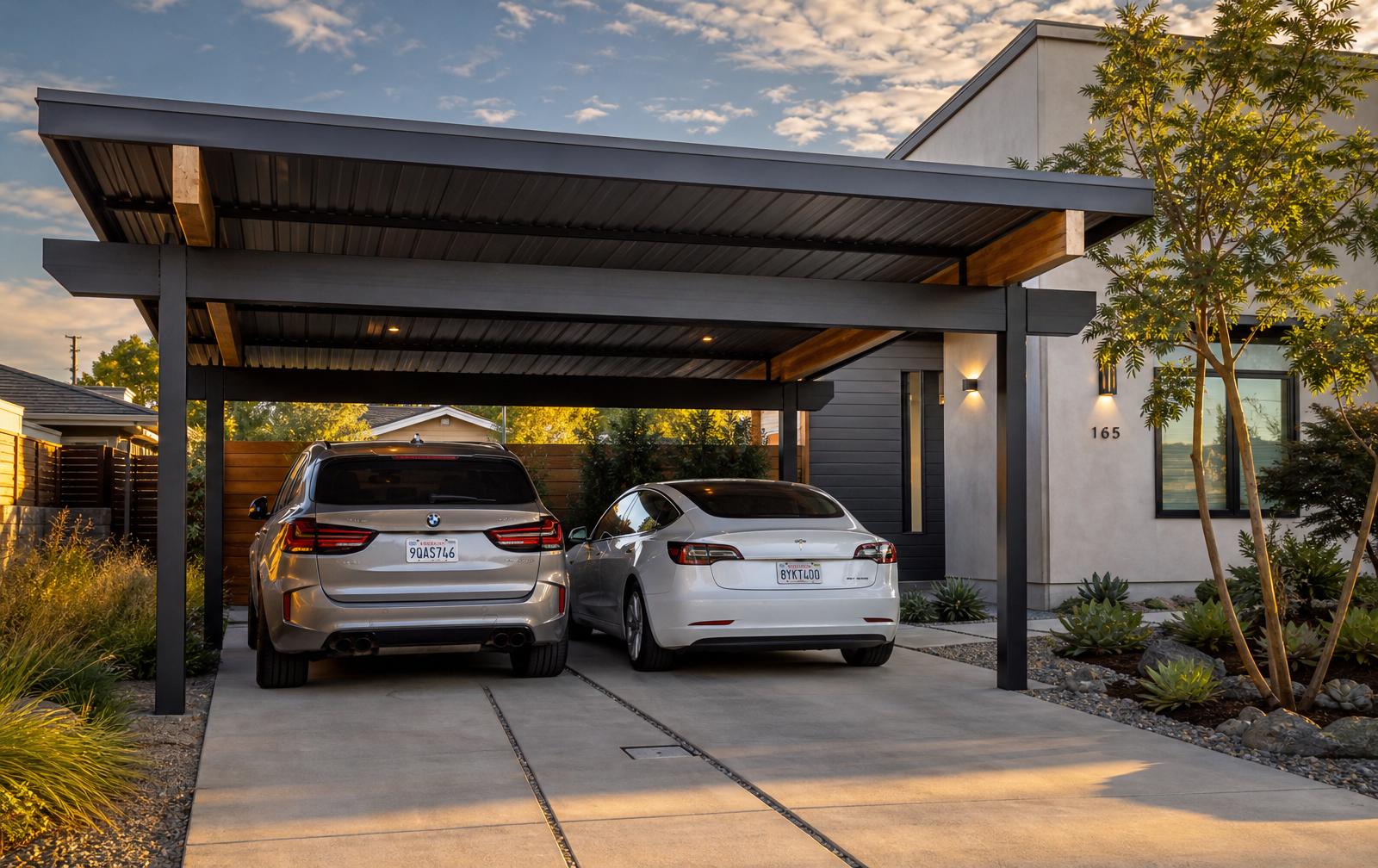
A carport in the Houston market today typically runs $6,500 – $28,000 for a licensed, insured, permitted contractor in 2026.
Where the budget goes
| Line item | Share of budget |
|---|---|
| Materials | 50% |
| Labor | 35% |
| Design & Engineering | 5% |
| Permits & Inspections | 5% |
| Contingency | 5% |
Percentages shift slightly by scope — labor share climbs on retrofit work, materials share climbs on high-finish selections.
Good, Better, Best — what the tiers actually get you
| Tier | Price | What's included | Expected lifespan | Warranty | Typical failure mode |
|---|---|---|---|---|---|
| Good | $6.5k – $11k | Aluminum kit carport on concrete pad, single-car | 10–15 yrs | 5-yr frame | Wind uplift damage in storms; aluminum dents |
| Better | $11k – $18k | Steel post-and-beam, metal roof matched to home, double-car | 25+ yrs | 10-yr | Sealant at wall attachment |
| Best | $18k – $28k | Engineered wood or steel with matching architecture, shingled roof, integrated drainage, insulated ceiling | 40+ yrs | 10-yr structural | Minimal |
Long-term cost of ownership
Aluminum kits routinely fail Houston hurricane wind ratings and get replaced after the next Category 2. A stamped engineered structure is a one-time buy.
The point is not that Good-tier work is always wrong — it's the right call for a rental, a flip, or a short hold. For a primary residence you plan to keep 10+ years, the math almost always favors Better tier, and Best tier makes sense when you want zero maintenance headaches.
ROI and resale
Expect 55–70% recoup at sale for a well-executed project in Houston. Adds appraisal value only when permitted and stamped; unpermitted structures are a lender flag.
For long-hold owners the bigger financial story is usually operating cost, insurance, or avoided repairs — not appraisal lift. Ask your contractor to quantify those specifically for your home and neighborhood.
What legitimately drives cost up
- Wind-load engineering stamp
- Foundation footings vs. surface-mount
- Roofline tie-in to existing house
None of these are markups — they're line items that must be in the scope to get the lifespan the tier promises. If a bid is missing them, you'll pay for them later, at retail, on your own.
Red flags in a low bid
- No permits pulled. Un-permitted work does not appraise, can void insurance, and gets flagged in a future sale.
- No proof of insurance or license. Ask for the certificate and the TDLR/state license number in writing.
- No written scope of work. Every material, model number, and quantity should be listed — verbal scopes are how "extras" appear later.
- Cash-only or 50%+ deposit up front. Standard is 10–20% deposit, milestone draws against completed work.
- Sub-market labor. If your bid is 30%+ below three other reputable bids for the same scope, the missing dollars are coming out of materials, insurance, or warranty coverage.
Bottom line
Get three itemized bids at the tier you want, compare line-item by line-item (not just the total), and pick the contractor who explains their number rather than the one who just discounts it. That's how you buy the right project once instead of the wrong project twice.