The difference between a whole-home repipe project that lasts and one that becomes a callback is almost always in the details that don't show up in a low bid.
These are the specs and design decisions our team insists on for every Houston home — the ones that quietly separate a real professional install from a cheap one.
1. PEX-A with expansion fittings
PEX-A with expansion (not crimp) fittings is the current best practice for repipes.
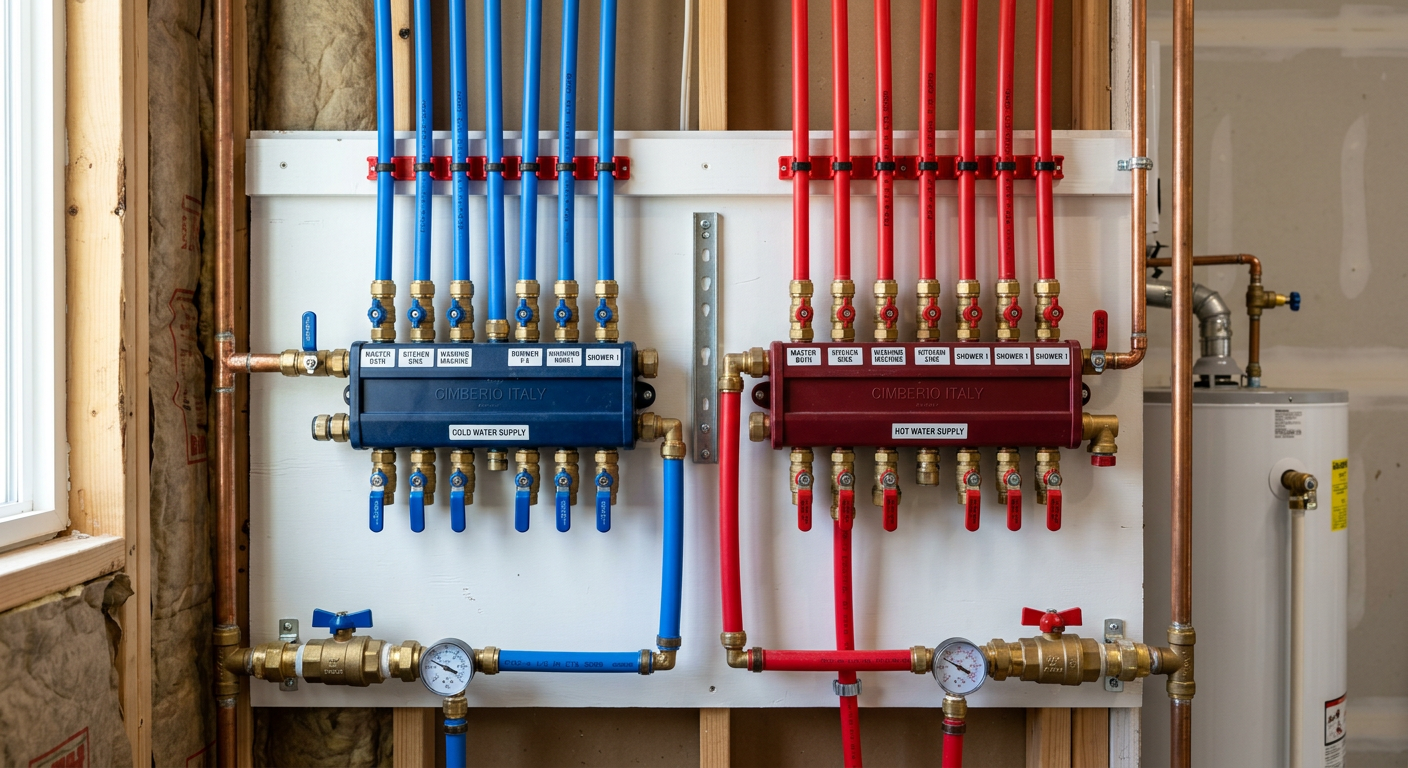
2. Home-run manifold system
A manifold in the utility room gives you a shutoff to every fixture — game-changing for repairs.
3. Full replacement, not partial
Repiping half the house leaves the failing half to leak next. Do the whole thing while walls are open.
4. Correct pipe sizing per fixture
Undersized branches mean weak flow. Proper fixture-unit sizing per the plumbing code.
5. Insulation on hot lines
Wrapping hot-water PEX cuts recirc energy and prevents condensation issues in walls.
6. Permit and inspection
Whole-home repipes require a permit in Houston. Do it right or resale will hurt.
7. New shutoffs at every fixture
Old multi-turn stops fail. Quarter-turn ball-valve stops at every fixture during the repipe.
8. Pressure regulator and expansion tank
A PRV set to 60–65 psi and a properly sized expansion tank protect the new system.
9. Drywall repair scope in the bid
A repipe damages walls. Confirm who patches, textures, and paints — and to what standard.
10. Water-heater tie-in reviewed
A repipe is the moment to right-size and rebuild the water heater connections.
The bottom line
Any of these can be skipped to hit a lower price — and every one of them will show up as a problem within a few years. Ask any contractor bidding your whole-home repipe project which of these are included, in writing. The honest ones welcome the question.
If you'd like to walk through what these look like on your specific home, our team is happy to do a no-pressure consultation.