Selecting the right thermostat is one of the simplest yet most influential decisions you can make for your home’s comfort and energy bills. While it is easy to get lost in the marketing of touchscreens and voice controls, the real differences lie in how these devices communicate with your heating and cooling equipment. Choosing the wrong type can leave you with an inefficient system, uneven room temperatures, or a device that simply will not work with your existing wiring.
Here is a practical guide to the four main categories of thermostats, how they handle complex HVAC systems, and how to choose the right one for your home.
1. Non-Programmable Thermostats: Simple and Utilitarian
Non-programmable thermostats are the digital equivalent of the old round mercury dials. You press an arrow up or down to set a temperature, and the system works to maintain that single setpoint until you manually change it again.
There are no schedules, no wireless connections, and no automated adjustments.
- Best For: Rental properties, guest houses, or homeowners who prefer complete simplicity without a learning curve.
- Pros: They are highly reliable, very inexpensive, and run for years on a couple of AA batteries.
- Cons: They offer zero energy savings unless you are disciplined enough to manually adjust the temperature every time you leave the house or go to sleep.
2. Programmable Thermostats: Scheduled Comfort
Programmable thermostats allow you to set a schedule based on your daily routine. Most models offer a "5-2" schedule (one program for weekdays, another for weekends) or a "7-day" schedule where every day can be programmed individually.
By automatically easing the workload on your air conditioner when you are at work or asleep, these units can reduce your cooling costs by 5% to 10%. To achieve these savings, you need to set reasonable "setbacks"—adjusting the temperature 7 to 10 degrees Fahrenheit warmer in the summer (or cooler in the winter) for at least eight hours a day.
- Best For: Homes with set, predictable daily routines and owners who want set-and-forget savings without connecting their HVAC system to the internet.
- Pros: Affordable, reliable, and highly effective if programmed correctly.
- Cons: They are notoriously frustrating to program using tiny, non-intuitive buttons on small LCD screens. If your schedule changes unexpectedly, the energy savings quickly disappear.
3. Smart Wi-Fi Thermostats: High-Tech Convenience
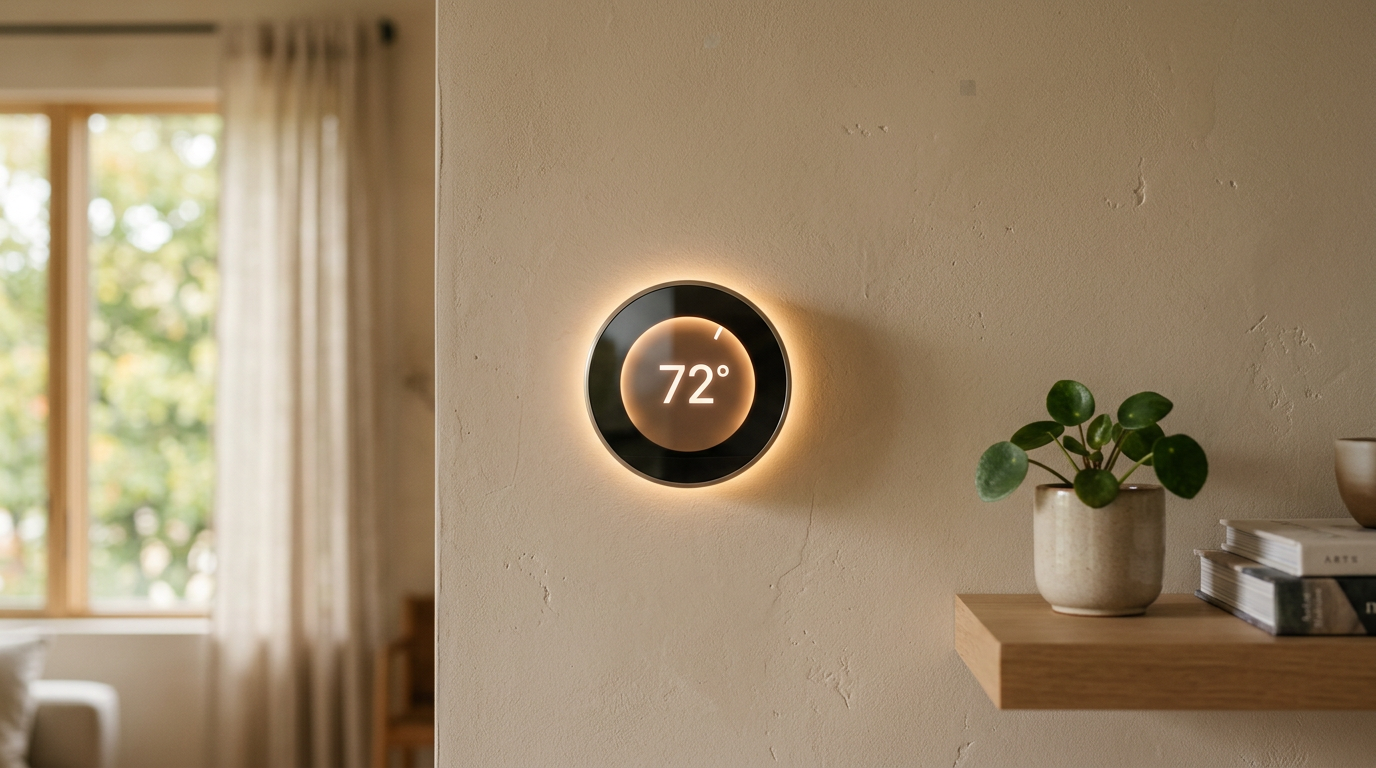
Smart thermostats connect to your home’s Wi-Fi network, allowing you to monitor and control your HVAC system from an app on your phone, tablet, or smart home hub. They go far beyond basic scheduling to optimize comfort and efficiency on the fly.
+------------------------+-------------------------------------+------------------------------------------+
| Feature              | Smart Wi-Fi Thermostats             | Communicating Thermostats                |
+------------------------+-------------------------------------+------------------------------------------+
| Control Type           | App-based, Wi-Fi, Geofencing        | Full digital integration with system     |
| Equipment Matching     | Works with most standard brands     | Proprietary (must match system brand)  |
| Efficiency Optimization| User behavior & geofencing          | Precise variable-speed motor adjustment |
| Ideal System Type      | Single or multi-stage systems       | Variable-speed inverter systems          |
+------------------------+-------------------------------------+------------------------------------------+
Key Features of Smart Thermostats
- Geofencing: Uses your phone's GPS to detect when you leave a pre-determined boundary around your house, automatically setting the AC to an energy-saving mode and cooling the house back down just as you return.
- Occupancy Sensing: Built-in motion sensors detect if anyone is active in the home, overriding schedules to keep the house comfortable when you are home unexpectedly.
- Energy Reports: Monthly digital breakdowns show exactly how many hours your system ran, allowing you to track how changes in your behavior affect your utility bills.
- Smart Home Integration: Native compatibility with platforms like Amazon Alexa, Google Home, and Apple HomeKit.
Popular Smart Models Compared
- Ecobee Smart Thermostat Premium: Excellent for multi-story homes or houses with uneven temperatures. It ships with a wireless remote room sensor that measures both temperature and occupancy in a distant bedroom or office, averaging the readings with the main unit to eliminate hot spots.
- Nest Learning Thermostat: Perfect for those who do not want to program a schedule. During its first week, it monitors when you wake up, leave, and return, automatically building a custom schedule based on your habits.
- Honeywell Home T9: A highly reliable option with a classic, user-friendly interface. Like Ecobee, it utilizes smart room sensors to balance temperatures across different rooms.
- Emerson Sensi Touch: A practical, no-nonsense smart option that often fits into existing wall footprints without needing a cosmetic trim plate. It focuses on reliable Wi-Fi performance without overly complex learning algorithms.
4. Communicating Thermostats: System-Matched Performance
While smart thermostats are highly capable, they still act as simple on/off switches for most standard HVAC systems. Communicating thermostats, such as the Carrier Infinity, Trane ComfortLink, or Lennox S40/iComfort, operate on a completely different level.
These proprietary devices are designed to ship paired with premium, high-efficiency variable-speed inverter systems. Instead of sending standard 24-volt electrical signals to turn a fan on or off, they communicate digitally, sharing data back and forth with the outdoor condenser, indoor furnace, and blower motor.
- How They Work: A standard thermostat can only tell a system to turn on 100%. A communicating thermostat can tell a variable-speed air conditioner to run at precisely 37% capacity to maintain a perfectly steady temperature and extract maximum humidity from the air.
- The Comfort Factor: Because they modulate output in tiny increments, they deliver the most precise comfort, lowest humidity levels, and quietest operation available in residential HVAC.
- The Catch: Communicating thermostats are proprietary. They usually lock you into the same-brand equipment. If you have a Carrier Infinity system, you must use a Carrier Infinity control to access its high-efficiency features. Installing a standard smart thermostat on these systems often degrades them to basic single-stage performance, defeating the purpose of your investment.
Wiring and Compatibility Basics
Before buying any thermostat, you must understand your system's underlying wiring.
Single-Stage vs. Multi-Stage Compatibility
- Single-Stage (1H/1C): Your system has one speed for heating and one speed for cooling. Almost any thermostat on the construction market will work with this.
- Multi-Stage (2H/2C or more): Your system has a high and low speed. You must ensure your chosen thermostat specifically supports multi-stage equipment so it can call for "Stage 1" for mild days and "Stage 2" for extreme weather.
The C-Wire (Common Wire) Requirement
Almost all modern smart Wi-Fi thermostats require continuous 24-volt power to run their color screens, Wi-Fi radios, and processors. This power is delivered through a blue or black wire known as the C-wire (Common wire).
Older homes with manual or programmable thermostats often only have two to four wires behind the wall, missing the C-wire entirely.
       TYPICAL THERMOSTAT WIRING

       [ R ] ---- Red (24V Power)
       [ G ] ---- Green (Indoor Fan)
       [ Y ] ---- Yellow (AC Compressor)
       [ W ] ---- White (Heat)
       [ C ] ---- Blue/Black (Common Power Return) *Required for Smart*
If you pop your current thermostat off the wall and do not see a C-wire, you have three options:
- Look for a Hidden Wire: Sometimes, installers pull a five-wire bundle but wrap the unused blue wire around the insulation jacket inside the wall. Pull the wire bundle gently out of the drywall to see if an unused wire is tucked away.
- Use a C-Wire Adapter: Brands like Ecobee and Nest sell C-wire adapter kits (often called Power Extender Kits). These small modules install inside your indoor furnace or air handler cabinet, splitting the signals of your existing four wires to safely power the smart thermostat without running new wires through your walls.
- Pull New Thermostat Wire: If you are undergoing a larger renovation, having an HVAC professional run a modern 18/8 thermostat wire from your equipment to the wall is the most robust, permanent solution.
Managing Zoning: Dampers, Multiple Systems, and Mini-Splits
If you have rooms that are constantly too hot or too cold, a new thermostat alone may not solve the problem. How you manage different temperature zones in your home depends heavily on your system's architecture.
Zoning with Dampers
In a damper-zoned system, a single HVAC unit pushes air through ductwork split into different zones (such as upstairs and downstairs). Motorized dampers inside the ducts open and close based on the demands of independent thermostats in each zone. These zones feed back into a central zone control panel. If you have this setup, your smart thermostats must be compatible with your specific zone control board.
Multiple HVAC Systems
Many larger or multi-story homes use two entirely independent heating and cooling systems—one for the main living areas and one for the bedrooms. In this case, you will need two separate thermostats. Upgrading both to the same smart brand allows you to monitor and control both zones from a single app on your phone.
Ductless Mini-Splits
If you have a ductless mini-split system, standard smart thermostats like Nest or Ecobee usually will not work out of the box because mini-splits use proprietary infrared or digital communication. Instead, you will use the manufacturer's remote controls, brand-specific wall controllers, or specialized smart controllers (like Cielo or Sensibo) that mimic infrared remote signals to give you smartphone control.
A Note on Realistic Energy Savings
Thermostat manufacturers often advertise energy savings of up to 23% or more. While these numbers are technically possible under laboratory conditions when upgrading from a completely unmanaged system, real-world savings are typically more modest.
In most markets, a well-managed smart or programmable thermostat will save you between 5% and 12% on your utility bills. The brand of the thermostat—whether Nest, Ecobee, or Honeywell—has very little to do with these savings. The real driver of efficiency is the size of your temperature setbacks and how consistently you use them. A basic, properly programmed $30 thermostat will save more energy than a premium $250 smart thermostat that is constantly kept at a static 71 degrees all summer long.
Find a device with an interface you enjoy using, make sure it is compatible with your home's wiring, and let automation do the work of keeping your home comfortable and efficient.
If you are planning an upcoming home renovation, addition, or equipment upgrade and want to ensure your heating, cooling, and control systems are designed for peak efficiency, we are here to help. Contact us at Modern Builders of America to schedule a free in-home estimate and discuss your project with one of our experienced remodeling specialists.