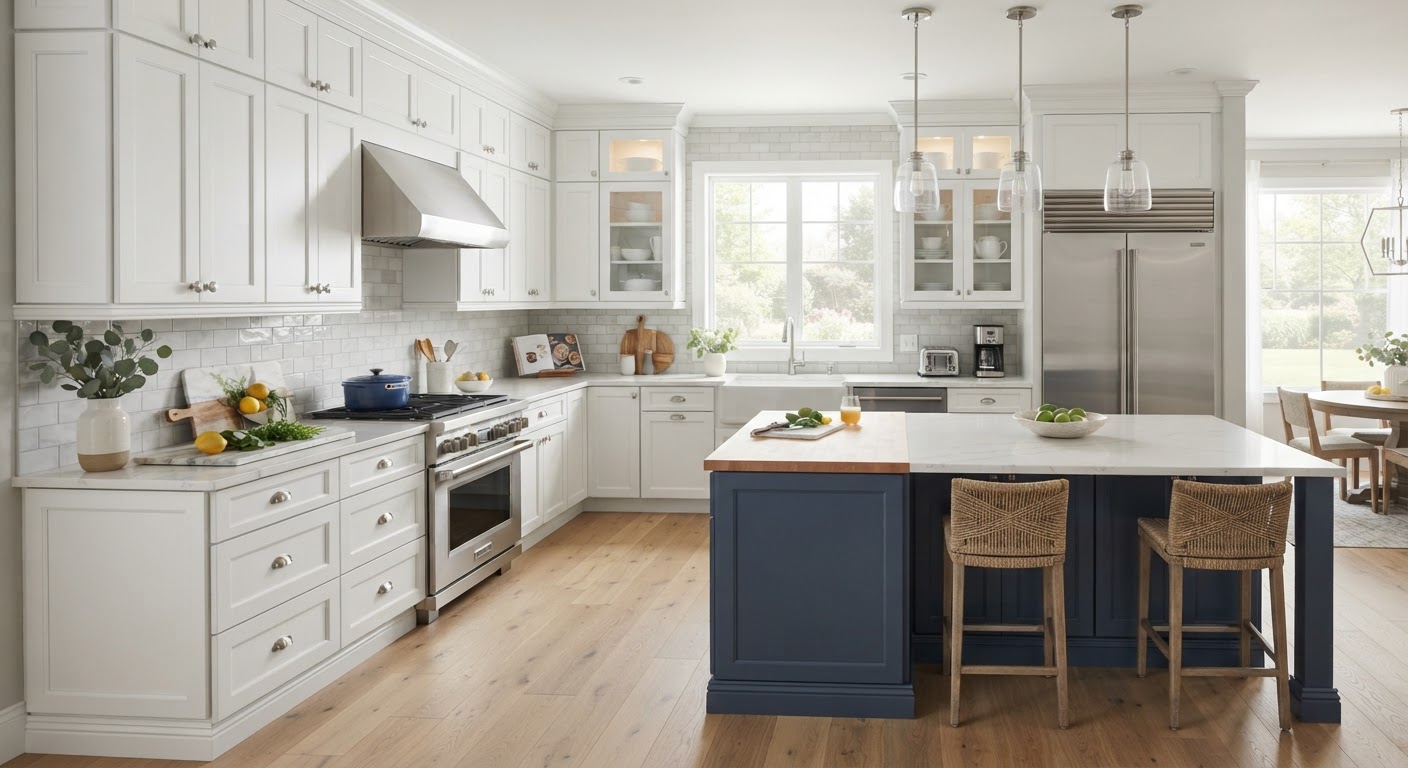
Cabinets are the single biggest driver of how your kitchen looks, functions, and lasts. They are also where most contractors quietly cut corners. This guide walks through the cabinet decisions that actually matter for a kitchen remodel — box construction, door style, hardware, hinges, and finish — with the trade-offs spelled out.
Stock, semi-custom, and custom cabinets
Stock cabinets are pre-built in fixed sizes (usually 3" increments). They ship fast and cost the least, but you'll have gaps hidden with filler strips, and the interior materials are almost always particleboard with a thin melamine skin.
Semi-custom cabinets are built to order from a fixed menu of sizes, door styles, and finishes. You get plywood box upgrades, more accurate sizing for your walls, and better hardware. This is the sweet spot for most kitchen remodels.
Custom cabinets are built for your exact space by a local shop. Any size, any wood species, any finish, integrated appliance panels, mitered doors, inset construction. Best fit, best longevity, highest price.
Box construction: plywood vs. particleboard
The box (the cabinet carcass behind the doors) is what actually holds your countertops, dishes, and pots. Cheap boxes sag, swell if they get wet, and blow out the screws holding your hinges after a few years.
- 3/4" plywood boxes — what we install by default. Won't swell if a dishwasher leaks, holds screws tightly, supports heavy stone countertops without deflection.
- 5/8" or 1/2" particleboard/MDF — the industry-standard "budget" option. Fine for a rental flip, not what you want under $8k of quartz.
Door style and construction
Shaker doors are the most common for a reason: they're timeless, they hide minor movement in the wood, and they work in traditional and modern kitchens. Slab doors read modern; raised-panel reads traditional.
Look for solid wood door frames with a plywood or MDF center panel. Full-MDF slab doors are fine for painted finishes but chip at the edges if bumped.
Hinges and drawer slides — where cheap kitchens give themselves away
- Soft-close hinges and undermount soft-close drawer slides should be standard, not upgrades. Blum and Blumotion are the benchmark.
- Full-extension drawers let you actually reach the back. Half-extension slides are a corner cut.
- 6-way adjustable hinges let us re-align doors after the house settles. Cheap 2-way hinges can't be tuned.
Hardware, organization, and the small stuff
Pull-out trash, tray dividers, spice pull-outs, and a deep drawer stack under the cooktop change how the kitchen feels day-to-day far more than the door color does. Plan these before ordering, not after.
Built-in buttons for the garbage disposal and soap dispenser on the countertop or cabinet face keep the sink area clean and are trivial to add during rough-in — and impossible to add later without tearing things apart.
Finish, paint, and moisture
Factory-catalyzed conversion varnish is far more durable than site-applied paint. If you're painting cabinets yourself or hiring a painter to do it on-site, expect touch-ups within 2–3 years around the sink and trash pull-out.
What we do at Modern Builders
We default to plywood boxes, soft-close everything, full-extension drawers, and Blum-grade hardware — no upcharge line items to unlock the basics. We also fabricate custom countertops with mitered edges to match the cabinet lines, and rough in the disposal/soap-dispenser buttons during electrical, not after.
Planning a kitchen remodel? Contact us for an honest quote — we'll walk you through every cabinet line item so you know exactly what you're paying for.