Every time you turn on a faucet, flush a toilet, or run the dishwasher, a complex network of hidden pipes goes to work. This system, known as the drain, waste, and vent (DWV) system, relies entirely on gravity to carry wastewater out of your living spaces and safely into the municipal sewer main or your private septic tank.
For most homeowners, these pipes are out of sight and out of mind—until a slow drain, a mysterious backup, or a damp spot on the drywall brings them to your attention. Understanding the materials behind your walls and beneath your yard can help you make smart decisions during a remodel, diagnose issues early, and protect one of your largest investments.
Inside the Walls: Drain, Waste, and Vent (DWV) Pipes
The plumbing inside your home is divided into supply lines (which bring clean water in under pressure) and drain lines (which use gravity to carry dirty water and sewer gases out). The interior DWV system requires sturdy, reliable pipes that won't leak or corrode over decades of use.
Several materials have dominated residential construction over the last century, and each has its own characteristics, lifespan, and installation requirements.
| Pipe Material | Common Use | Est. Lifespan | Key Pro | Key Con |
| :--- | :--- | :--- | :--- | :--- |
| **ABS** | West Coast waste/vent | 50+ Years | Easy to cut & glue | Can warp in high heat |
| **PVC** | Modern standard DWV | 50+ Years | Strong, inexpensive | Multi-step gluing process |
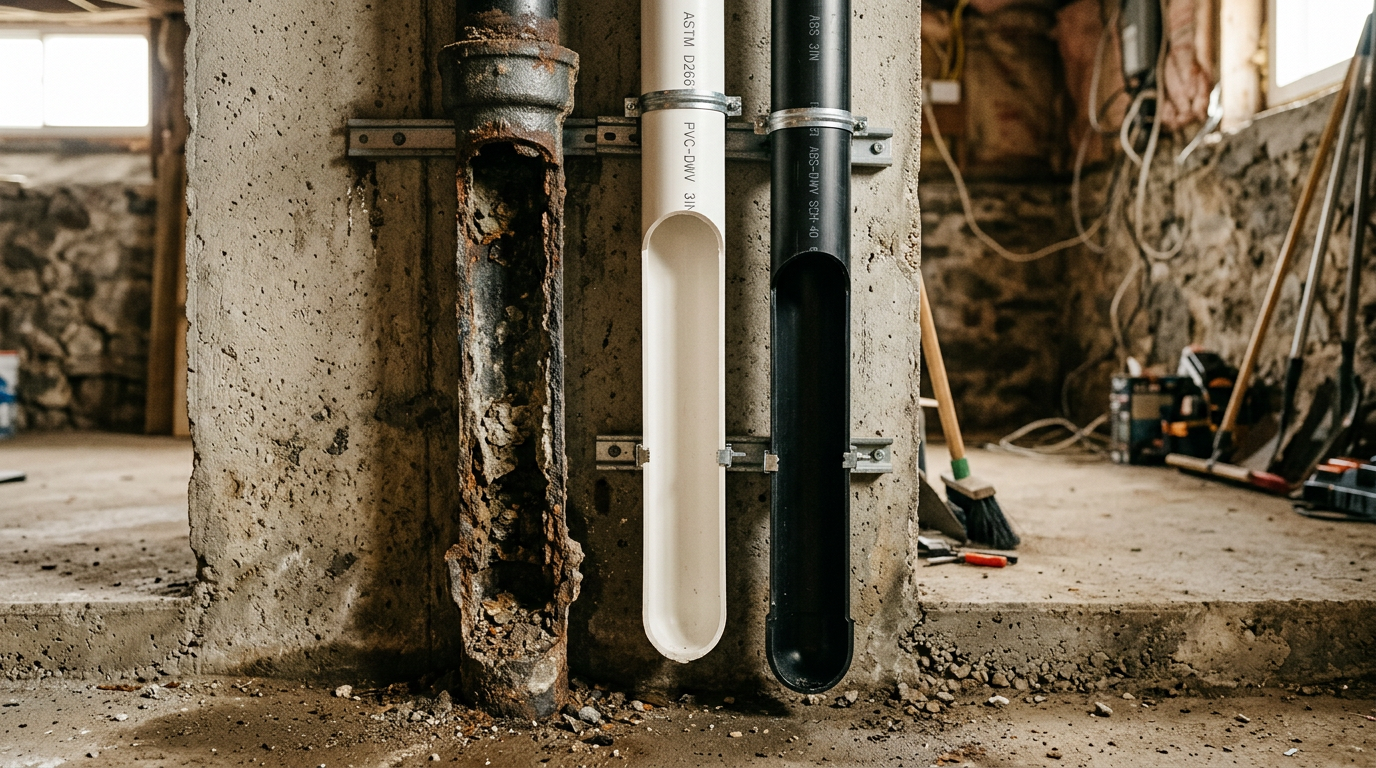
| **Cast Iron** | Vintage homes & premium builds | 50–100 Years | Extremely quiet | Rusts and scales internally |
ABS (Acrylonitrile Butadiene Styrene)
If you live on the West Coast or in certain parts of the Midwest, there is a very high probability that your modern waste lines are made of ABS. Easily recognized by its slick, matte-black finish, ABS is a rigid plastic pipe designed specifically for drainage systems.
- Lifespan: You can expect 50 to 80 years of reliable service from well-installed ABS.
- Installation: It is highly favored by plumbers because it is lightweight, easy to cut with a hand saw, and joined using a simple, one-step cement process.
- Pros & Cons: It is highly resistant to impact and cold temperatures, making it less likely to crack in winter. However, it can warp if exposed to prolonged, direct sunlight before installation, and some local building codes restrict its use in commercial structures due to fire propagation rules.
PVC (Polyvinyl Chloride)
If you live on the East Coast, in the South, or in modern suburban builds across much of the country, white PVC is the standard choice for interior drainage.
- Lifespan: Like ABS, PVC boasts an incredibly long life expectancy of 50 to 100 years. It does not rust, rot, or corrode over time.
- Installation: Unlike ABS, joining PVC is a two-step chemical welding process. Installers must first apply a purple-dyed primer to clean the plastic and soften the surface, followed quickly by a specialized PVC solvent cement. This double-ring connection creates a virtually indestructible joint.
- Pros & Cons: PVC is slightly more rigid than ABS and stands up exceptionally well to high-pressure situations, though it can be slightly more brittle in freezing temperatures during installation.
Cast Iron
For generations, heavy, dark-gray cast iron was the undisputed king of residential waste lines. While plastic has largely taken over the residential market due to cost and ease of installation, cast iron remains a hallmark of older homes and is still selectively used in high-end custom home construction today.
- Lifespan: High-quality cast iron can last anywhere from 50 to 100 years, or even longer in dry, well-ventilated environments.
- The Sound Factor: This is cast iron’s greatest modern selling point. Plastic pipes are thin-walled; when a second-floor toilet flushes, you can often hear the rush of water cascading down through the walls of your living room or kitchen. Cast iron is so thick and dense that it absorbs that acoustic energy entirely, resulting in dead-silent drainage. Many premium builders will install cast iron for the vertical main stacks of a home and transition to plastic for the horizontal branches to get the best of both worlds.
- The Downside: Cast iron is incredibly heavy, difficult to install, and eventually rusts from the inside out. Over the decades, the interior walls of a cast iron pipe can develop a rough, scaly texture that snags hair and debris, eventually leading to frequent clogs.
Outside the House: Exterior Sewer Laterals
Once the individual drains in your home merge into one single pipe, that pipe exits the foundation of your house. This section of pipe is called the "sewer lateral," and it runs underground to connect your home to the city main under the street. Because it is buried deep and subjected to shifting soil, heavy vehicle traffic, and thirsty tree roots, the materials used here are critical.
Modern PVC and SDR-35
For modern lateral replacements and new builds, heavy-duty plastic is the gold standard. Homebuilders typically use schedule 40 PVC or a specialized, slightly thinner-walled version known as SDR-35 (Standard Dimension Ratio). SDR-35 is manufactured specifically for gravity-flow sewer systems, is often colored green, and features gasketed push-fit joints that allow for slight shifting in the earth without cracking. Both options are impervious to root intrusion when properly sealed, and they will easily last upwards of 100 years underground.
Clay Tile
If your home was built before the 1970s, your lateral is likely made of vitrified clay pipe. These are short, heavy sections of fired clay fitted together like nested cups.
- Lifespan: Clay itself is incredibly durable and can easily survive 60 to 80 years in the ground without degrading.
- The Vulnerability: The weakness of clay is not the pipe material, but the joints. Traditional clay pipe sections were sealed with mortar or simply packed with tar and oakum. Over time, these joints decay and pull apart as the ground shifts. Trees sense the moisture escaping from these joints and send microscopic root systems inside. Once inside, the roots thrive on the warm, nutrient-rich water, expanding until they completely block or break the pipe.
Orangeburg Pipe
During the mid-20th century, specifically from the 1940s through the early 1970s, a material called Orangeburg pipe was widely used as a cheap alternative to cast iron or clay. Orangeburg is essentially a conduit made from layers of wood pulp bound together with liquefied coal tar pitch.
Put simply, it is compressed, tar-impregnated paper. While it was marketed as a 50-year pipe, most Orangeburg lines begin to fail dramatically after 30 years. As it absorbs moisture and is subjected to the weight of the soil above, the pipe turns oval, delaminates, and eventually collapses entirely. If you have Orangeburg pipe on your property, it is not a matter of if it will fail, but when.
No-Dig Solutions: Trenchless Sewer Replacement
In the past, replacing a collapsed or root-ravaged sewer lateral meant bringing a backhoe onto your property, digging a deep, muddy trench through your manicured lawn, cutting up your driveway, and rebuilding your landscaping from scratch. Today, specialized plumbing contractors can often perform trenchless sewer replacements that require only one or two small access pits.
Pipe Bursting
Pipe bursting is a highly efficient method used to fully replace a severely damaged lateral. A large, steel, cone-shaped bursting head is pulled through your old pipe by a heavy-duty hydraulic winch. As the cone is pulled forward, it physically shatters your old clay, cast iron, or Orangeburg pipe and pushes the fragments outwardly into the surrounding soil. Connected to the back of the bursting head is a brand-new, continuous run of flexible High-Density Polyethylene (HDPE) pipe, which is pulled into place instantly.
CIPP (Cured-In-Place Pipe) Lining
Often referred to as sewer relining, CIPP is essentially building a brand-new, seamless pipe inside your old one. A technician inserts a flexible, epoxy-saturated felt tube into the existing lateral. Once positioned, they inflate the bladder inside the tube with air or steam, pressing the wet epoxy firmly against the walls of the old pipe. After the resin cures and hardens (which takes just a few hours), the bladder is deflated and removed, leaving behind a smooth, jointless plastic sleeve that is highly resistant to leaks and tree roots. Note that CIPP cannot be used on pipes that have completely collapsed or lost their structural shape.
Essential Safety and Maintenance Features
A well-designed drainage system isn't just about the pipes; it also includes critical safety and maintenance points that prevent major disasters.
Sewer Cleanouts
A sewer cleanout is an accessible pipe stub with a threaded cap, usually located just outside your foundation wall, in your basement, or near the street curb. This access point allows plumbers to insert high-pressure water jetters, cameras, or mechanical snakes directly into your lateral to clear blockages without having to dismantle pipes inside your home. Every home should have at least one easily accessible main cleanout.
Backwater Valves
If your home has a basement or lower level with plumbing fixtures that sit below the level of the municipal sewer grates in the street, you are at risk for a sewage backup. If the city main clogs or surcharges during a heavy rainstorm, raw sewage can back up through your lateral and emerge from your basement floor drains, showers, or basins.
A backwater valve is a mechanical gate installed on your main line that only allows water to flow out of your home. If water begins to flow backward from the street, a lightweight flap floats up and seals the pipe shut, protecting your home from catastrophic water damage.
+-------------------------------------------------------------+
|               HOW A BACKWATER VALVE PROTECTS YOU            |
|                                                             |
|   NORMAL FLOW (Outbound)           CITY SEWER BACKUP        |
|                                                             |
|         [ To City ]                  X [ From City ]        |
|             ^                              |                |
|             |                              v  (Blocks Flow) |
|         /---o---\                     /---[o]---\           |
|        /  Flap   \                   /  Closed   \          |
|       |  Open     |                 |    Gate     |         |
|        \         /                   \           /          |
|         \       /                     \         /           |
|             ^                              |                |
|             |                              X                |
|       [ From Home ]                  [ Basement Protected ] |
|                                                             |
+-------------------------------------------------------------+
The Wisdom of a Sewer Scope Before Buying
If you are in the market to buy a home, especially one built before 1990, a standard home inspection is not enough. Most home inspectors run the taps and flush the toilets to ensure water flows, but they cannot see what is happening twenty feet down the line inside the ground.
A sewer scope is a quick, inexpensive service where a technician runs a high-definition color camera on a flexible cable all the way from your home’s cleanout to the city main. They will check for:
- Cracked, offset, or dropped joints.
- Low spots, also known as "bellies," where water pools and collects debris.
- Heavy root intrusion that could cause an imminent backup.
- The presence of failing materials like Orangeburg or decaying clay.
Discovering a failing main sewer line before you close on a home can save you thousands of dollars in emergency repairs and give you the leverage you need to negotiate a repair credit with the seller.
Whether you are preparing for a major kitchen remodel, planning a basement bathroom addition, or simply want to ensure your home's infrastructure is sound, keeping your drainage system updated is key to peace of mind. If you suspect your plumbing is showing its age, or if you would like to explore upgrading your home's waste lines, reach out to us at Modern Builders of America to schedule a free in-home estimate.