Your driveway is more than just a place to park your car; it is the physical transition from the public road to your private sanctuary. It represents a significant portion of your home’s curb appeal and represents a major financial investment that should last for decades.
Choosing the right material isn't just about picking a color or matching your neighbor’s yard. You have to balance regional climate challenges, local HOA rules, maintenance habits, and the physical realities of your home’s natural drainage. Here is an honest, contractor-grade breakdown of the most common driveway materials, how they perform over time, and what actually makes a driveway last.
The Foundation of Every Long-Lasting Driveway
Before diving into materials like concrete, asphalt, or pavers, we must address the single most critical factor in driveway construction: the subgrade.
The vast majority of driveway failures—whether wide cracks in concrete, deep ruts in asphalt, or sagging pavers—are not actually failures of the surface material. They are subgrade failures.
┌────────────────────────────────────────┐  ◄── Driveway Surface
│              Road Base                 │  ◄── 4" to 6" Compacted Base
├────────────────────────────────────────┤
│           Compacted Subgrade           │  ◄── Prepared Soil
└────────────────────────────────────────┘
Every hard-surface driveway requires a solid foundation:
- The Excavation: The existing topsoil, organic matter, and loose dirt must be excavated down to stable, virgin soil.
- The Road Base: A non-negotiable layer of 4 to 6 inches of crushed gravel or road base (often called ¾-inch minus) must be laid down.
- Compaction: This base must be mechanically compacted until it is rock-solid. Without this stable, draining foundation, any heavy vehicle or seasonal freeze-thaw cycle will shift the ground underneath, resulting in immediate structural damage to your new driveway.
Water and Slope: The 2% Rule
Water is the ultimate enemy of residential hardscaping. A driveway must never allow water to pool on its surface or run back toward your home’s foundation.
The industry standard for driveway slope is a minimum of 2%. This means the driveway must slope downward away from the house at a rate of 1/4 inch per foot. Additionally, the driveway should be designed to shed water to the sides into natural landscape drainage areas rather than concentrating a torrent of runoff directly into the public street or a neighbor’s yard.
Design Dimensions: Planning for Real Life
Before pouring or laying any material, ensure your dimensions accommodate modern vehicles and daily life:
- Single-Car Width: A minimum of 10 feet. This allows room for doors to open without passengers stepping directly onto grass or mud.
- Double-Car Width: A minimum of 20 feet.
- Turn-Around Space: If you live on a busy road, budgeting space for a "Y" turn-around (typically a 10x20 foot hammerhead branch) prevents you from having to back out into traffic.
Comparing Driveway Materials
Each material has unique characteristics, maintenance requirements, and life expectancy. Below is an honest look at how they compare.
| Material | Lifespan | Primary Benefit | Main Drawback | Maintenance Needs |
|---|---|---|---|---|
| Standard Concrete | 30–40 Years | High durability, low maintenance | Prone to cracking | Occasional sealing, washing |
| Asphalt | 20–25 Years | Cost-effective, handles freeze/thaw | Softens in extreme heat | Sealing every 3–5 years |
| Individual Pavers | 30–50+ Years | Beautiful, easy to repair | Highest upfront cost | Joint sanding, weeding |
| Exposed Aggregate | 30–40 Years | Excellent traction, upscale look | Rough on bare feet | Regular sealing to prevent stone pop-outs |
| Stamped Concrete | 25–35 Years | High-end look of stone for less | Can be slippery when wet | Frequent resealing to preserve color |
| Gravel/Crushed Stone | Variable | Lowest initial cost | Unfriendly to snowplows & HOAs | Regular grading and top-offs |
1. Standard Concrete: The Reliable Workhorse
Concrete is the most common driveway material in North America for a reason. It is exceptionally rigid, highly durable, and presents a clean, neutral appearance that complements almost any home style.
Pros:
- Long Lifespan: A properly installed concrete driveway can easily last 30 to 40 years.
- Low Maintenance: Beyond periodic pressure washing and occasional sealing, it requires very little day-to-day attention.
- Load Bearing: High-PSI concrete handles heavy SUVs and delivery trucks without rutting.
Cons:
- Prone to Cracking: Concrete is inherently prone to shrinking and cracking. To manage this, installers must cut control joints (grooves cut at least one-quarter of the slab's depth) every 8 to 10 feet. This encourages the concrete to crack cleanly inside the joint rather than across the visible face of the driveway.
- Staining: Oil, transmission fluid, and leaf tannins will stain bare concrete easily if not cleaned immediately.
- Expansion Joint Requirements: Concrete expands and contracts with shifting temperatures. Flexible expansion joints must be installed anywhere the driveway meets another rigid structure, like your garage apron or sidewalks, to prevent buckling.
2. Asphalt: Flexible and Cost-Effective
Often referred to as blacktop, asphalt is a mixture of stone aggregate and a sticky, petroleum-based binder. It is laid hot and compacted with heavy rollers.
Pros:
- Lower Upfront Cost: Asphalt is typically significantly cheaper to install than concrete or pavers.
- Cold-Weather Performance: The dark surface absorbs heat from the sun, melting snow and ice much faster than lighter materials. Additionally, asphalt is flexible, making it highly resistant to damage from seasonal freezing and thawing.
- Seamless Appearance: It offers a clean, continuous dark look that hides oil leaks and tire marks well.
Cons:
- Shorter Lifespan: You can expect 20 to 25 years of service, even with excellent maintenance.
- Heat Sensitivity: In extreme summer heat, asphalt can soften slightly, making it susceptible to indentation from heavy, pointed loads like motorcycle kickstands or trailer jacks.
- High Maintenance: To prevent the binder from oxidizing and turning gray and brittle, you must coat it with an asphalt sealer every 3 to 5 years.
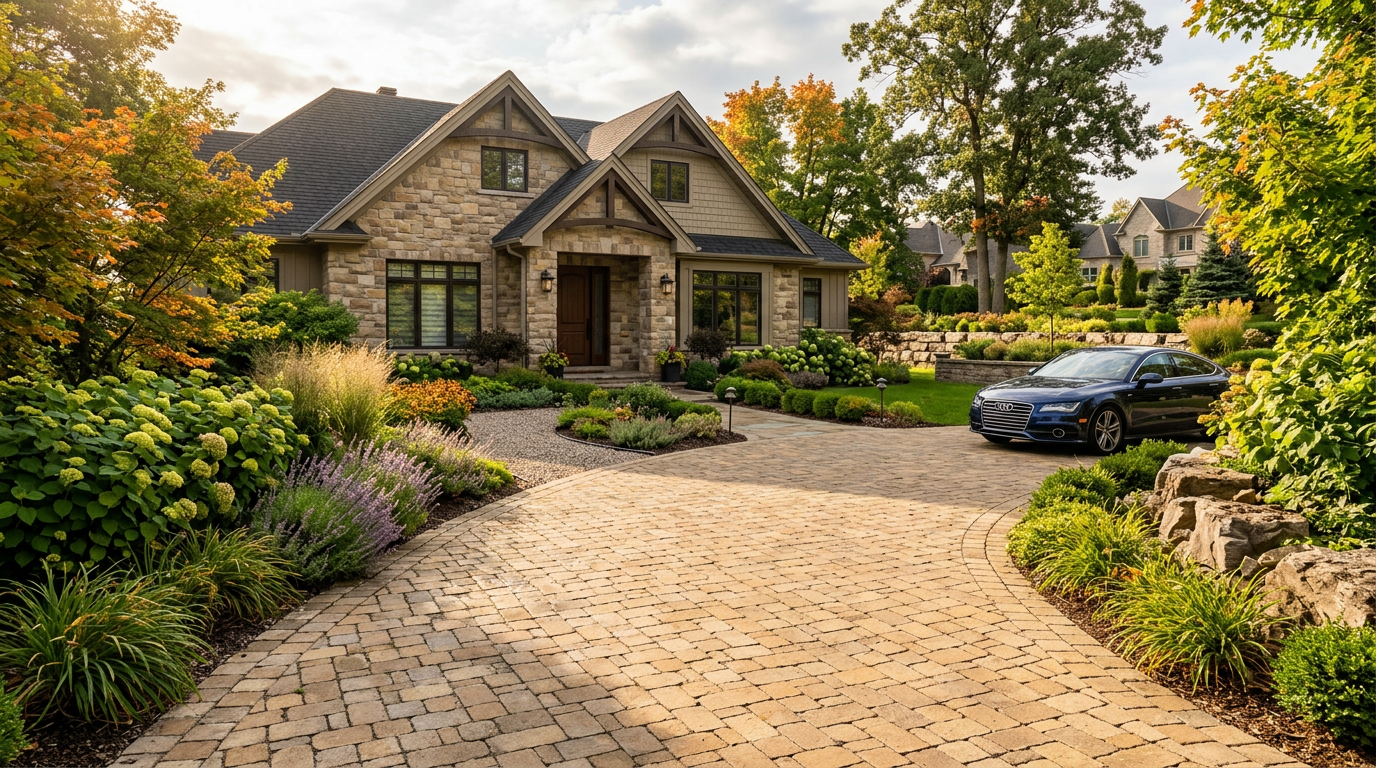
3. Concrete & Clay Pavers: The Architectural Premium
Driveway pavers are individual blocks made of either cast concrete or kiln-fired clay. They are hand-laid over a bed of compacted sand and secured with joint sand.
Pros:
- Unmatched Aesthetics: Pavers offer an upscale, luxurious custom look with endless options for patterns, colors, and borders.
- Easy Repairability: If a section of your driveway is stained by an oil leak or damaged by tree roots, you do not have to tear up the whole driveway. You simply pull up the affected pavers, repair the base, and drop those same pavers—or new ones—back in.
- Flexibility: Because they are individual units, the driveway bends and flexes with ground movement without cracking.
Cons:
- High Cost: This is typically the most expensive upfront driveway investment due to the intense manual labor required for installation.
- Weed Growth: If the sand joints are not maintained, weed seeds blowing in from the yard will take root in the gaps. You must use polymeric sand (sand that hardens when wet) and replenish it periodically to prevent this.
Permeable Pavers for HOA Compliance
If your neighborhood or local municipality has strict regulations regarding stormwater runoff and impervious surface limits, permeable pavers are an excellent solution. They are designed with wider joints filled with tiny stones rather than sand, allowing rainwater to filter directly through the driveway and back into the ground rather than overwhelming city storm drains.
4. Exposed Aggregate: Texture and Character
Exposed aggregate is created by pouring standard concrete and then spraying a chemical retarder on the top layer. Before the concrete fully cures, the top layer of cement paste is washed away with water, exposing the decorative gravel and stones embedded within the mix.
Pros:
- Upscale Look: It offers a highly textured, organic, three-dimensional appearance that masks dirt and minor stains exceptionally well.
- Superior Traction: The raised stones provide excellent slip resistance, making it an ideal choice for steep hills or regions with heavy rain and snow.
Cons:
- Barefoot Comfort: The rough texture can be uncomfortable to walk on with bare feet.
- Stone Shift: Over time, individual stones can pop out of the surface if the concrete is not sealed every few years.
5. Stamped or Stained Concrete: Crafted Elegance
Stamped concrete is poured just like standard concrete, but while it is still wet, large rubber mats are pressed into the surface to mimic the texture of natural slate, brick, or flagstone. Staining can be added to give the surface a realistic, multi-toned stone appearance.
Pros:
- High-End Look for Less: You get the look of expensive pavers or natural stone at a more accessible concrete price point.
- No Individual Shifts: Unlike pavers, there are no joints for weeds to grow through.
Cons:
- Slippery Texture: The sealants used to protect the color and patterns can make stamped concrete incredibly slick when wet or icy. Installers must mix a non-slip grit additive into the sealer to mitigate this.
- Hard to Match Repairs: If stamped concrete cracks or needs a patch, matching the exact color and pattern of the original pour is incredibly difficult.
6. Gravel and Crushed Stone: The Budget Alternative
For rural properties, long country lanes, or historic homes, gravel driveways remain a practical option. They consist of multiple layers of stone, starting with baseball-sized rocks at the bottom and ending with fine, crushed stone on top.
Pros:
- Highly Affordable: It is by far the cheapest option to install over large areas.
- Excellent Drainage: Water flows naturally through the stones, preventing pooling.
Cons:
- High Maintenance: Gravel shifts. You will need to rake it back into place, pull invasive weeds, and top it off with fresh stone every few years.
- Neighborhood Restrictions: Most suburban HOAs and municipalities strictly ban gravel driveways due to runoff and aesthetic rules.
- Snow Removal Dilemma: Shoveling or snowblowing a gravel driveway is difficult without throwing stones into your yard or damaging your equipment.
Making the Right Choice for Your Home
Investing in a new driveway is about balancing your home’s architectural style, your local weather patterns, and how much time you want to spend maintaining the exterior of your home. No matter which material you choose, remember that the preparation work beneath the surface determines whether your investment lasts for forty years or fails in five.
If you are ready to upgrade your home’s curb appeal and want a driveway built to the highest structural standards, we invite you to reach out to the team at Modern Builders of America for a free, detailed in-home estimate. Our experienced project managers will evaluate your property's soil, layout, and drainage to help you choose and build the perfect entrance to your home.