When the wind starts howling and the lights flicker out, your home quickly transitions from a sanctuary of modern convenience to a cold, dark shelter. Reliable backup power is no longer just a luxury for rural properties; it has become a necessity for suburban homeowners facing increasingly frequent grid failures, extreme weather, and overworked utility infrastructure.
Choosing how to protect your household from the next blackout is one of the most practical investments you can make, but the market is flooded with competing technologies. Navigating the choices between portable generators, permanently installed standby units, and whole-home chemical batteries requires understanding how you use power, what you are willing to maintain, and how much you want to invest in peace of mind.
Portable Generators: Budget-Friendly and Manual
The most accessible entry point into emergency power is the portable generator. These units typically run on gasoline, diesel, or dual-fuel setups that allow you to switch to liquid propane (LP) canisters.
Conventional Portables vs. Inverter Generators
A standard open-frame portable generator is a workhorse, but it has two major drawbacks: noise and "dirty" power. Conventional generators run at a constant high speed (usually 3,600 RPM) to maintain 60Hz AC power, which creates a loud roar and produces electrical current with relatively high Total Harmonic Distortion (THD). This electrical noise can overheat or damage sensitive modern electronics, like your laptop, smart television, or the microprocessor boards inside your modern HVAC system and refrigerator.
Inverter portables are a vastly superior choice for residential backup. They use a digital processor to clean up the electricity, producing a pure sine wave with less than 3% THD, which is completely safe for sensitive electronics. Additionally, inverters can throttle their engines up or down based on the actual electrical load, making them significantly quieter and far more fuel-efficient than their open-frame counterparts.
Safe Connection vs. The "Suicide Cord"
If you choose a portable generator, you must connect it to your home safely. Renters or budget-conscious homeowners often run long, heavy-duty extension cords through a cracked window directly to a few appliances. While tedious, this is safe.
What is absolutely never acceptable is using a male-to-male extension cord—commonly referred to in the trades as a "suicide cord"—to plug a generator directly into a standard wall outlet. This illegal practice backfeeds live electricity into your home’s electrical panel and back out onto the municipal power lines. This presents an immediate, lethal electrocution hazard to utility lineworkers trying to restore grid power, and it carries an incredibly high risk of starting a house fire.
| Connection Method | Pros | Cons |
|---|---|---|
| Manual Transfer Switch | Isolates selected circuits; very safe; prevents utility backfeeding. | Limits you to a set list of 6 to 10 hardwired circuits. |
| Interlock Kit | Low-cost; allows you to power any circuit up to the generator’s capacity. | Requires manual load management to avoid overloading the generator. |
A manual transfer switch or an interlock kit installed on your main panel by a licensed electrician is the only safe way to run your home on portable power. With an interlock kit, a mechanical sliding plate ensures that your main utility breaker must be switched off before the generator breaker can be turned on, keeping your home isolated and your family safe.
Standby Generators: Automated, Continuous Muscle
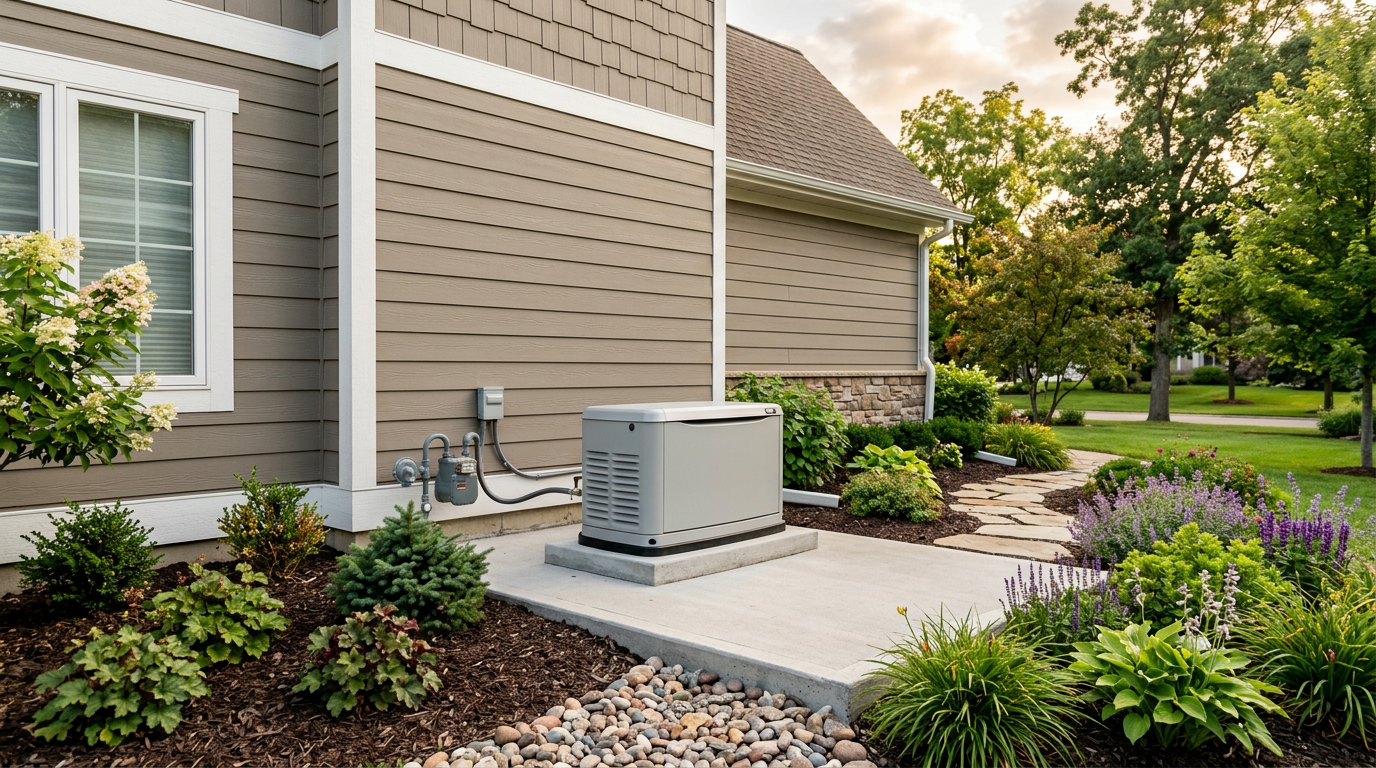
If you want your home to keep running seamlessly without stepping foot outside in a storm, a permanently installed standby generator is the gold standard. These units, ranging from 14 kW to 26 kW for most residential applications, sit on a concrete or composite pad outside your home, much like a central air conditioning condenser.
Standby generators are fueled by your home’s natural gas line or an on-site liquid propane tank. They are wired directly to your electrical system through an Automatic Transfer Switch (ATS).
When the grid fails, the ATS instantly detects the loss of voltage. Within 10 to 30 seconds, it commands the generator to start, switches your home's load away from the dead utility lines, and routes the generator's power into your panel. You do not have to pull cords, pour fuel in the dark, or even be at home for this system to protect your property from freezing pipes or a flooded basement.
The primary trade-off for this hands-free reliability is ongoing maintenance. Standby generators utilize internal combustion engines that require regular oil changes, spark plug replacements, and valve adjustments—typically after every 100 hours of continuous run time, along with an annual professional service. Because they run on volatile fuels, standby generators also require strict adherence to local setback codes to keep exhaust fumes away from windows and doors.
Whole-Home Batteries: Silent, Clean, and Smart
Whole-home lithium batteries—such as the Tesla Powerwall 3, Enphase IQ, FranklinWH, and SolarEdge Home Battery—represent the cutting edge of residential energy resilience. Instead of burning fuel to create electricity, these systems store power from the grid or an on-site solar array to use when the grid goes down.
Batteries are completely silent, require virtually zero maintenance, and produce no emissions, making them ideal for tight suburban lots where generator noise and exhaust would annoy neighbors or violate municipal ordinances. They also switch over instantly during an outage—often so fast that your clocks won't even blink.
The crucial limitation of a battery-only system is runtime. While a standby generator will run indefinitely as long as natural gas flows, a battery has a finite reservoir of energy. A single battery unit will typically power your essential loads (refrigerator, lights, internet, and a few outlets) for 12 to 24 hours.
To survive an extended multi-day outage with batteries alone, you must pair them with a solar panel system designed to recharge the batteries during the day. If the weather remains overcast for several days, your solar production will drop, and you will have to strictly ration your power usage.
The Hybrid Approach: The Perfect Compromise
For homeowners who want the ultimate in resilience, combining a whole-home battery with a standby generator offers the best of both worlds.
In a hybrid configuration, the battery acts as the primary defense. When the power goes out, the battery seamlessly takes over, providing silent power through the night. If the outage persists and the battery's state of charge drops below a set threshold, the system automatically commands the generator to start. The generator then runs at its most efficient capacity to quickly recharge the battery bank and power heavy appliances, and then shuts off.
This hybrid cycle drastically reduces your overall fuel consumption, minimizes generator wear and tear, and ensures you enjoy quiet, peaceful nights even during a widespread, week-long utility crisis.
Infrastructure and Behind-the-Scenes Engineering
Upgrading your home’s backup power is not as simple as dropping equipment in the yard. It requires careful balance and upgrading of your home's existing infrastructure.
Sizing Your Load
Before buying any equipment, you must decide what you actually need to power.
- Essentials Backup: This focuses purely on survival and basic comfort. It covers your refrigerator, freezer, Wi-Fi router, a few LED light circuits, and charging ports for phones. An emergency setup like this typically requires 3,000 to 5,000 watts of power.
- Whole-Home Backup: This allows you to live uninterrupted. It runs your central air conditioner, electric oven, well pump, and perhaps even an EV charger. This level of demand requires a heavy-duty system, usually starting at 20,000 watts (20 kW) or multiple stacked batteries.
                  TYPICAL POWER REQUIREMENTS

 [ Essentials: 3-5 kW ] ────────► Fridge, Wi-Fi, LEDs, Phone Chargers

 [ Managed Whole-Home: 10-18 kW ] ─► Essentials + Well Pump, Sump Pump, 1 AC Unit

 [ Full Whole-Home: 20 kW+ ] ────► Essentials + Multiple AC Units, EV Charger, Oven
Load Shedding Modules
To prevent your generator or battery from stalling under a sudden spike in demand, we use load shedding modules. If your HVAC system and your electric water heater try to start at the exact same moment, the load shedding system temporarily pauses power to the water heater until the HVAC compressor finishes its high-energy startup cycle. This smart management allows you to buy a smaller, more budget-friendly generator or battery system without sacrificing your ability to run large appliances.
Gas Lines and Permitting
For standby generators, the fuel delivery system is a frequent bottleneck. A 22 kW generator requires a significant volume of natural gas, often requiring your local utility to upgrade your gas meter. The pipe running from your meter to the generator must be sized correctly; if the pipe diameter is too small, the generator will starve for fuel under heavy loads, leading to system shutdowns.
Furthermore, physical installations require mechanical and electrical permits from your local municipality. This process ensures the electrical transfer switches are wired safely, the gas lines are pressure-tested, and the unit is positioned safely relative to your property lines and bedroom windows.
The Reality of ROI
When investing in backup power, it is important to be realistic about your return on investment. Unlike kitchen remodels or bathroom upgrades, backup power systems do not offer a direct financial payback that you will see on a home appraisal or utility bill savings (unless you are using batteries to arbitrage high peak-use utility rates).
Instead, the return on investment for a backup power system is measured entirely in peace of mind. It is the financial value of preventing thousands of dollars in spoiled food, avoiding the massive headache and expense of remediating a flooded basement because your sump pump lost power, and knowing that your family will remain warm, safe, and connected no matter what happens to the grid outside.
If you are ready to evaluate your home's electrical capacity and find the right backup power strategy for your family, we can help. Reach out to the team at Modern Builders of America to schedule a free in-home estimate, and let's build a plan to keep your lights on.