Your countertop is the surface you'll touch every single day of owning your kitchen. It's also one of the few decisions that's genuinely hard to undo — swapping countertops usually means damaging the backsplash and sometimes the cabinets. Here's how to pick the right material the first time.
The realistic material shortlist
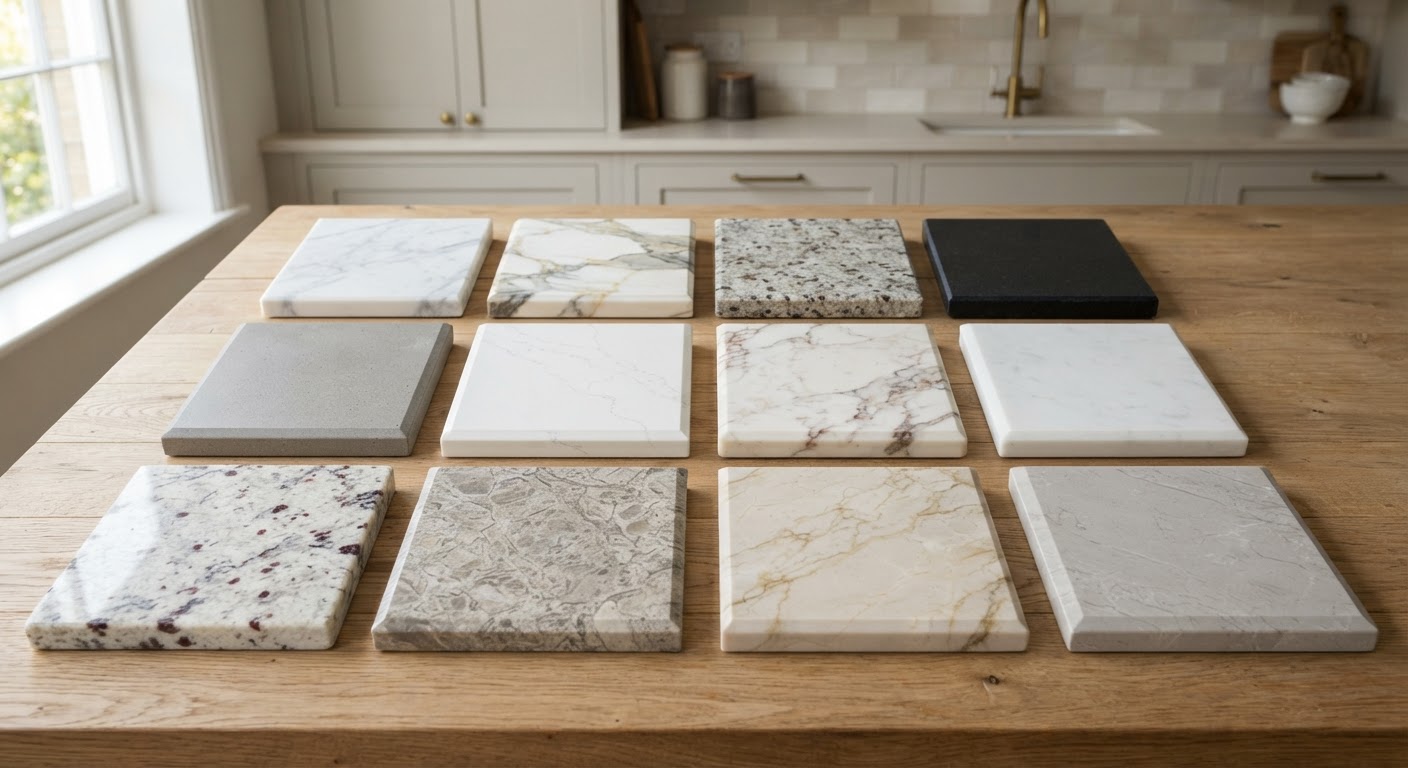
Quartz (engineered stone)
Ground natural quartz bound with resin. Non-porous, doesn't need sealing, extremely consistent pattern to pattern.
- Pros: Stain-proof, no sealing, huge range of looks including convincing marble knock-offs.
- Cons: Can scorch under a hot pan (the resin binder). Seams are visible on very light colors.
- Best for: Families, busy kitchens, anyone who doesn't want to babysit a countertop.
Granite (natural stone)
Quarried slabs, each one unique. Extremely hard and heat-tolerant.
- Pros: Puts hot pans directly on it. Massively durable. Every slab is one of a kind.
- Cons: Porous — needs sealing every 1–3 years or oil/wine will stain. Pattern varies wildly slab to slab; you need to see the actual slab, not a sample.
Quartzite (natural stone, often confused with quartz)
A natural metamorphic rock, not the engineered material. Harder than granite, marble-like veining.
- Pros: The look of marble with the durability of granite.
- Cons: Pricey. Must be sealed. "Soft quartzites" are really dolomitic marble in disguise — get an acid-etch test before buying.
Marble
Beautiful, classic, and etches the first time you set a lemon on it.
- Pros: Nothing else looks like it. Great for baking (naturally cool).
- Cons: Etches from anything acidic (vinegar, wine, tomato, citrus). Stains easily. Best treated as a surface that will develop a patina.
Butcher block
Warm, cheap-ish, easy to DIY.
- Pros: Affordable, refinishable, food-safe.
- Cons: Needs regular oiling. Cannot go near a sink long-term without water damage.
Laminate
Photo-printed paper on particleboard.
- Pros: Cheapest option. Fast install.
- Cons: Not heat-resistant. Chips at the edges. Water swells the substrate. Impossible to repair invisibly. Rarely worth it unless you're prepping to sell.
Edge profiles matter more than people think
A mitered edge (two pieces glued at 45° to look like a solid thick slab) is what makes a countertop look custom. Prefab counters with a bullnose edge always read builder-grade. We fabricate our countertops in-house so mitered edges and waterfall ends aren't an upcharge.
Realistic installed cost per square foot (2026 ballpark)
- Laminate: $30–$60
- Butcher block: $60–$120
- Quartz: $70–$150
- Granite: $60–$180
- Quartzite: $120–$220
- Marble: $100–$250+
Installed cost includes template, fabrication, sink/faucet cutouts, edge profile, seaming, and installation.
What we always install for you
Undermount stainless sinks, mitered edges when you want the thick look, and templated seams that hide behind cooktops or in low-visibility spots — not straight across your main run.
Ready to nail down your countertop? Reach out for a no-pressure quote and we'll bring slab samples to your kitchen.