When most homeowners think about drafty rooms or high energy bills, they immediately blame their heating and cooling systems. But even the most advanced furnace or air conditioner will struggle to keep you comfortable if your home’s thermal envelope is failing. Upgrading your insulation is one of the most effective, highest-return investments you can make in your property, provided you choose the right materials and install them correctly.
This guide will break down the differences between common insulation materials, explain how to interpret R-values for your region, and help you identify exactly when it is time to upgrade.
The Golden Rule: Air Sealing Comes First
Before comparing materials or calculating R-values, we have to address a critical physical reality: insulation is designed to slow down heat transfer, but it does not stop moving air. If you pile brand-new, expensive insulation over cracks, gaps, and open utility penetrations, winter air will still draft right through it.
Drafty air carrying moisture into your insulation can degrade the material and cause mold growth. That is why professional remodelers always perform air sealing before installing new insulation.
To prepare your home for insulation, you should first address these key areas:
- Utility Penetrations: Use expanding canned foam to seal gaps around plumbing stacks, electrical wires, and ductwork where they pass from your living space into the attic or crawlspace.
- The Attic Hatch: A classic source of heat loss. Seal the hatch cover with weatherstripping and attach a rigid piece of foam board to the top of the hatch itself.
- Recessed Lights: Standard can lights that pull heat directly into your attic should be replaced with airtight, insulation-contact (IC-rated) LED fixtures, or covered with certified fire-resistant covers and sealed from above.
- Chases and Top Plates: Seal the joints where drywall meets the wooden top frames of your interior and exterior walls.
Only when your home is properly air-sealed should you begin laying down or blowing in your insulation of choice.
Comparing Insulation Types
Different areas of your home demand different insulation performance characteristics. A material that works beautifully in an open attic floor may be a terrible choice for a tight rim joist in a damp basement.
| Insulation Type | Typical R-Value Per Inch | Best Applications | Primary Pros | Primary Cons |
|---|---|---|---|---|
| Fiberglass Batts | 3.1 – 4.3 | Open wall cavities, floor joists | Affordable, easy to handle | Performs poorly if compressed or fitted with gaps |
| Blown-In Fiberglass | 2.2 – 2.7 | Attics, dense-packed walls | Great for uneven joist spaces, fast install | Can settle over time, lower R-value per inch than cellulose |
| Blown-In Cellulose | 3.2 – 3.8 | Attics, existing closed walls | Eco-friendly, great sound dampening, resists airflow | Heavy when wet, dusty during installation |
| Mineral Wool | 3.0 – 4.2 | Interior walls, ceilings, basement joists | Unmatched fire resistance, excellent soundproofing | More expensive than fiberglass, heavier to work with |
| Open-Cell Spray Foam | 3.5 – 3.8 | Roof decks, interior wall cavities | Air seals and insulates in one step | Permeable to moisture, requires professional rig |
| Closed-Cell Spray Foam | 6.0 – 7.0 | Rim joists, crawlspaces, thin walls | Maximum R-value, acts as vapor barrier, adds strength | Highest cost, requires expert installation |
Fiberglass Batts
Fiberglass batts are the pre-cut blankets of pink, yellow, or white insulation you see nestled between studs in unfinished walls. Top brands like Owens Corning, Johns Manville, Knauf, and CertainTeed make high-quality batt options.
While fiberglass is affordable and relatively easy for DIYers to install, its performance drops drastically if it is squeezed or if there are gaps along the edges. If a 5.5-inch batt is compressed into a 3.5-inch wall cavity, it loses a significant portion of its insulating value. It also does nothing to stop air movement, meaning drafty walls will bypass the batts entirely.
Blown-In Fiberglass
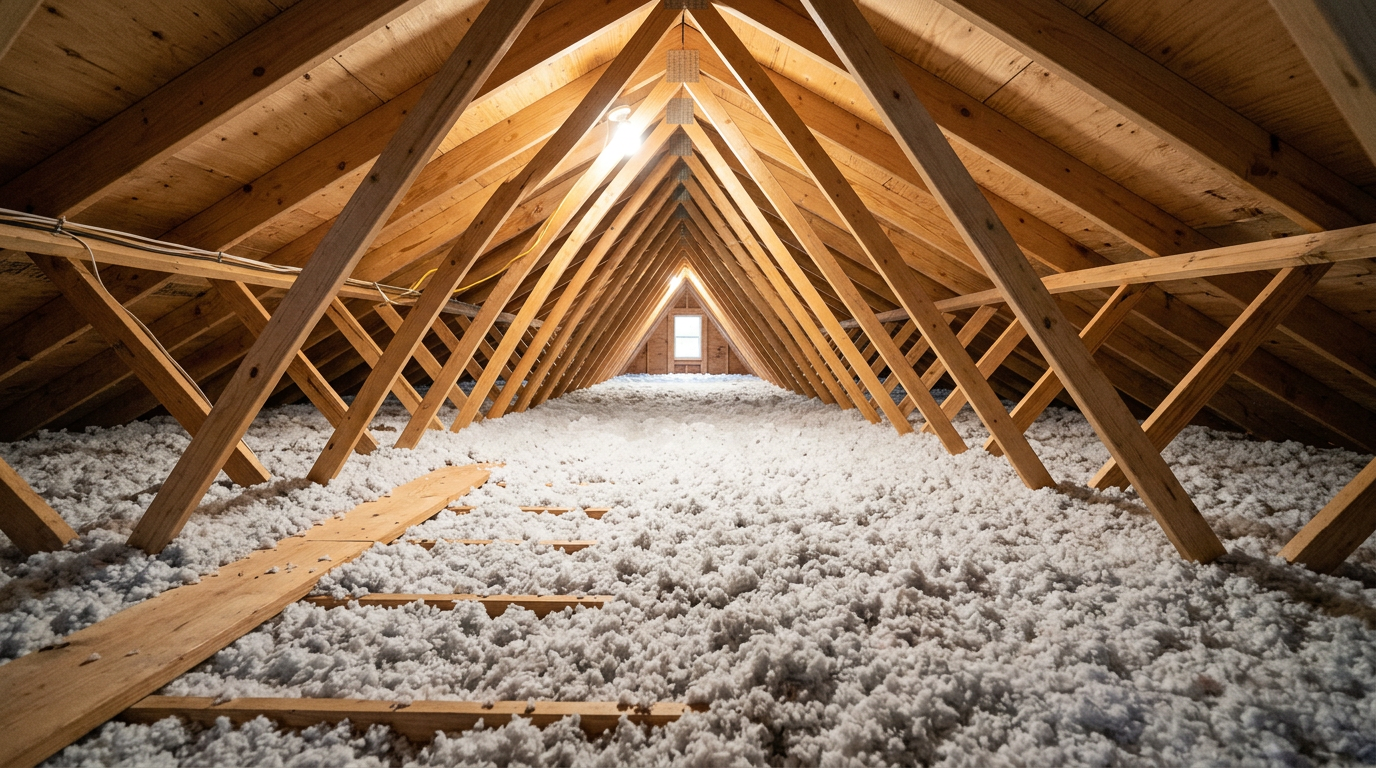
This material consists of loose-fill fiberglass fibers blown into place using a mechanical hopper and hose. It is an excellent choice for attics because it fills in around irregular ceiling joists, wiring, and pipes far more effectively than hand-cut batts. It is also a quick, cost-effective way to "top up" existing attic insulation that has settled but is otherwise in good condition.
Blown-In Cellulose
Cellulose is made from recycled newspaper treated with boric acid, making it highly resistant to insects, mold, and fire. Because the fibers are denser than fiberglass, blown-in cellulose offers superior sound deadening and does a much better job of slowing down air circulation.
The primary caveat is moisture: cellulose must be kept dry. If a roof leak or high humidity saturates cellulose, it can mat down, lose its R-value, and hold moisture against your wood framing.
Mineral Wool (Rockwool)
Made from spun volcanic rock and steel slag, mineral wool batts are dense, rigid, and naturally hydrophobic (they repel water). It is significantly more expensive than fiberglass, but it boasts a much higher melting point, making it an incredible fire barrier between garage walls or between floors.
Because of its density, mineral wool is also the gold standard for blocking sound transfer between bedrooms, bathrooms, and home offices.
Open-Cell Spray Foam
Open-cell foam expands rapidly when sprayed, creating tiny, air-filled pockets. Leading manufacturers like Icynene and Demilec formulate these foams to expand up to 100 times their liquid volume, allowing them to fill every nook and cranny in a wall cavity or roof deck.
At roughly R-3.5 to R-3.8 per inch, open-cell foam acts as an excellent air barrier, though it remains vapor-permeable. This means it allows moisture to dry through it, which is useful in certain cathedral ceiling assemblies but may require a separate vapor retarder in very cold climates.
Closed-Cell Spray Foam
Closed-cell foam is a dense, heavy-duty material where the cells are completely sealed and filled with a gas that helps expand the foam. It delivers an impressive R-6.0 to R-7.0 per inch, making it the most powerful insulator on the market.
Because it cures to a hard, rigid state, it actually adds structural strength to the walls. It also acts as its own water-resistant vapor barrier. Closed-cell is highly recommended for rim joists, damp crawlspace walls, and shallow wall cavities where you need to pack maximum thermal performance into a limited space.
National R-Value Targets: How Much Do You Need?
The term "R-value" refers to a material's resistance to conductive heat flow. The higher the R-value, the better the material insulates. Your target R-value depends entirely on the climate zone you live in.
The U.S. Department of Energy divides the country into zones. Here are the typical recommendations for major structural areas of your home:
Attics: R-38 to R-60
- Southern Climates (Zones 1-3, e.g., Texas): Homeowners in hot, humid areas should aim for R-38 to R-49. This stops intense summer attic heat from radiating down into your air-conditioned living space.
- Northern Climates (Zones 4-8): In cold, snowy regions, you want R-49 to R-60 to keep expensive furnace heat inside and prevent the snow on your roof from melting and refreezing.
Exterior Walls: R-13 to R-21
- Standard 2x4 framing typically accommodates R-13 to R-15 insulation.
- Modern 2x6 framing allows for thicker R-19 to R-21 insulation, which is standard practice in colder northern states.
Floors Over Unconditioned Space: R-19 to R-30
If you have a bonus room over a garage, or living space directly above an unheated basement or crawlspace, you need to insulate the floor joists to R-19 in the South, and up to R-30 in the North to keep floors comfortable underfoot.
When to Change Your Insulation
Insulation doesn't always last forever. Here are the clear signs that your home's thermal envelope needs professional attention:
1. Settled or Compressed Insulation
Over decades, loose-fill fiberglass and cellulose can pack down under their own weight. If your attic floor insulation has settled below the tops of your ceiling joists, you are likely losing a massive amount of heat through thermal bridging (where heat bypasses insulation by traveling directly through the wooden joists).
2. Rodent or Pest Intrusion
Mice, squirrels, and raccoons love to tunnel through fiberglass and cellulose to build nests. They leave behind droppings, urine, and biological contaminants that ruin the thermal performance of the material and create serious indoor air quality hazards. If you find pest damage, the insulation must be completely removed, the space sanitized, and new material installed.
3. Ice Dams on the Roof
If you notice large icicles forming along your gutters in the winter, you have an attic insulation and air sealing problem. Escaping house heat is warming up your roof deck, melting the snow above, and letting the water run down to the cold roof edge where it refreezes. This can back up under your shingles and cause expensive drywall damage inside.
4. High Energy Bills and Hot/Cold Rooms
If certain guest bedrooms stay freezing in the winter and stifling in the summer, or if your HVAC equipment is running constantly despite regular maintenance, your insulation is likely failing or insufficient.
5. Active Remodeling Projects
The absolute best time to upgrade your insulation is when you already have the drywall down for a kitchen, bathroom, or basement remodel. Adding spray foam or mineral wool during this window is incredibly cost-effective because the labor-intensive part of the job—opening the walls—is already done.
Upgrading your home's insulation is a straightforward way to trim your monthly utility bills, protect your roof from ice damage, and enjoy a quieter, more comfortable home year-round. If you are experiencing drafty rooms, high energy bills, or are planning a larger remodeling project, our team can help you map out the perfect insulation layout for your home. Reach out to Modern Builders of America today to schedule a free in-home estimate with one of our experienced field specialists.