Interior doors are one of those home details that you rarely notice when they are working well, but they instantly affect how a house feels once you touch them. When a door has a satisfying weight, swings smoothly, and shuts with a quiet, solid click, your entire home feels more substantial and well-crafted. If you are planning a remodel, upgrading your interior doors is one of the most effective ways to elevate your everyday living experience.
Choosing the right doors requires balancing how they look, how they perform, and where they are located. This guide will walk you through construction materials, architectural styles, specialty configurations, and the small hardware choices that make a big difference.
1. Door Construction: What’s Under the Paint?
The material inside your door dictates its weight, how well it blocks sound, and how much it will cost. Most homeowners are surprised to learn that doors with the exact same exterior appearance can have completely different cores.
| Core Type | Material Composition | Pros | Cons | Best Used For |
|---|---|---|---|---|
| Hollow-Core | Cardboard honeycomb wrapped in thin veneer | Lightweight, budget-friendly | Poor sound isolation, feels flimsy | Closets, pantries, low-traffic areas |
| Solid-Core MDF | Engineered wood fiber (Medium Density Fiberboard) | Excellent sound dampening, stable, paints beautifully | Heavy, requires sturdy framing | Bedrooms, bathrooms, home offices |
| Solid Wood | 100% natural lumber (pine, oak, poplar) | Beautiful wood grain, can be stained, incredibly durable | Expensive, prone to warping with humidity | Status areas, custom homes, historic restorations |
Hollow-Core Doors
These are the builder-standard doors found in many tract homes built over the last few decades. They consist of a cardboard honeycomb structure sandwiched between outer skins of wood or hardboard. While they are highly affordable and easy to hang, they offer almost no privacy because sound waves pass right through them.
Solid-Core MDF
For the vast majority of our remodeling projects, we recommend solid-core MDF (medium-density fiberboard) doors. MDF is incredibly dense, which makes these doors heavy and highly effective at blocking sound. Because they are engineered, they do not expand and contract with seasonal humidity changes, meaning they won't stick or warp in wet bathrooms. They are paint-grade doors, meaning they must be painted rather than stained, but they offer the best value-to-performance ratio on the market.
Solid Wood
If you want the natural grain of oak, maple, cherry, or walnut to show through under a clear stain, solid wood is your only option. These are premium, heavy-weight doors that offer a classic feel. However, because natural wood breathes, these doors require careful sealing and can warp or swell slightly during humid summers or dry winters.
2. Architectural Styles
The style of your doors should match the architectural language of your home. A sleek, modern slab door can look out of place in a Victorian home, while an ornate traditional door can disrupt a clean, minimalist design.
Flat Slab
This is a perfectly flat, smooth door with no paneling or decorative details. It is the go-to choice for mid-century modern, minimalist, and contemporary homes. Slab doors can be painted to match the walls or finished with beautiful wood veneers to create a warm, architectural focal point.
Multi-Panel Doors (2-Panel and 5-Panel)
Panel doors have vertical stiles and horizontal rails that frame recessed or raised panels.
- 2-Panel Doors: Often styled with a larger top arch or a simple square layout, these are highly versatile and work well in traditional, transitional, and farmhouse designs.
- 5-Panel Doors: Usually featuring horizontal panels stacked vertically, these doors are a staple of craftsman-style homes and bungalows. They have a classic, historic feel.
3-Panel Shaker
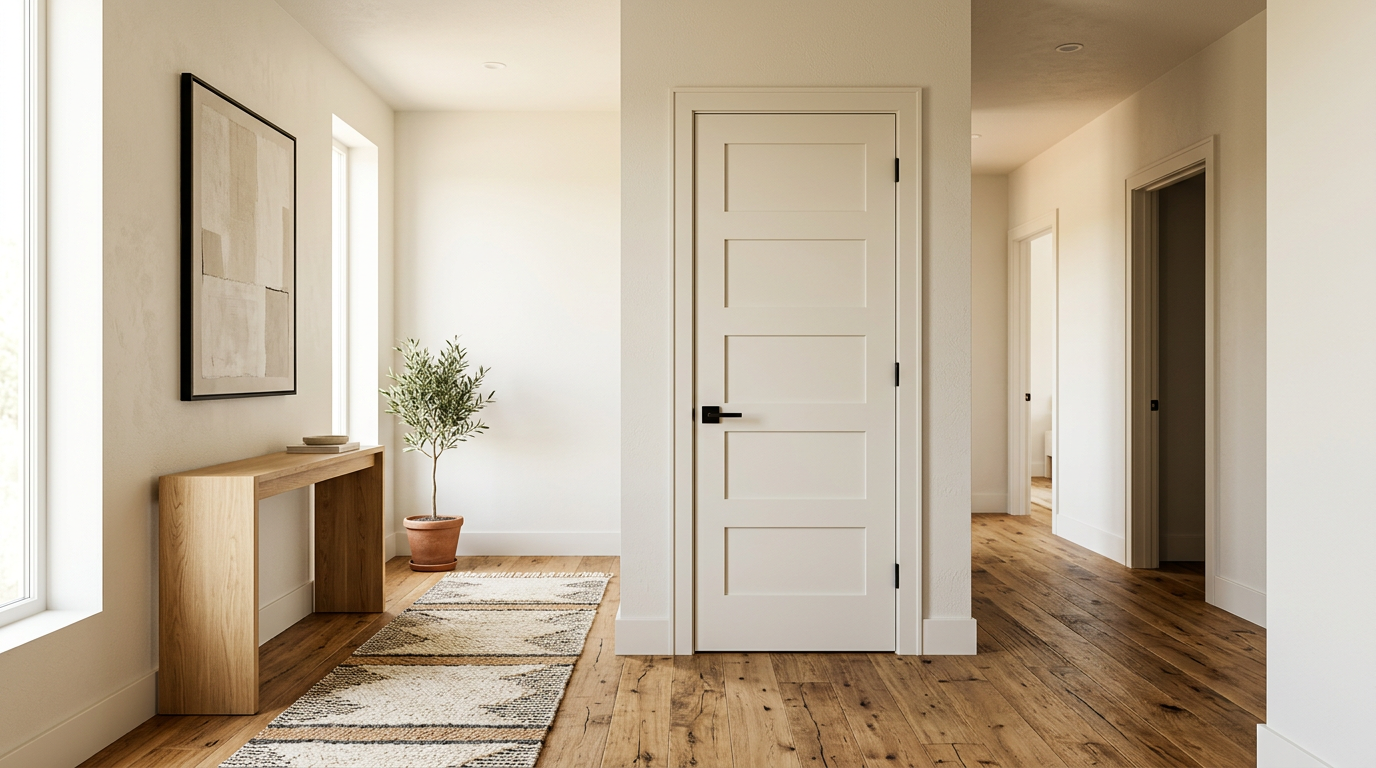
Shaker doors feature flat, recessed panels with clean 90-degree square edges instead of decorative molding profiles. The 3-panel Shaker design is currently one of our most popular requests because it acts like a chameleon; it sits comfortably in both traditional and highly modern spaces, offering clean lines without feeling sterile.
French and Glass Panel Doors
French doors feature glass panes that run the full length of the door, or a portion of it. They are ideal for spaces where you want to partition a room—like a home office or a dining room—but still want natural light to flow between spaces. You can choose clear glass for maximum light or frosted glass for privacy.
Louvered Doors
These doors feature horizontal wood slats that allow air to pass through even when the door is fully closed. They are highly functional for laundry closets, mechanical rooms, or pantries where ventilation is necessary to control moisture and heat.
3. Specialty and Space-Saving Doors
Standard swing doors require a clear radius of floor space to open. When space is tight, or when you want to make a distinct design statement, specialty door types are excellent alternatives.
[Standard Swing]  --> Requires floor space equal to the door width.
[Barn Door]       --> Slides along the wall; saves floor space but lacks privacy.
[Pocket Door]     --> Disappears completely into the wall; requires early framing.
Barn Doors
Sliding barn doors hang from a visible track mounted above the doorway. They are fantastic for adding visual character to a room and do not require any swing space. However, we always advise clients that barn doors have poor sound isolation and privacy. Because they sit slightly away from the wall to slide freely, there are gaps on the sides. They are best reserved for master bathroom entries, home offices, or dividing a den from a living area—not for public powder rooms or kids' bedrooms.
Pocket Doors
A pocket door slides directly into a cavity inside the wall framing, disappearing completely when opened. This is the ultimate space-saver for small bathrooms, walk-in closets, and tight hallways. Keep in mind that pocket doors must be planned early in the remodeling process. We have to frame the "pocket" during the rough-in stage, and we must ensure no plumbing pipes or electrical wires are running through that specific section of the wall.
Bi-Fold and Bypass Doors
Commonly used for bedroom and hallway closets, these options keep the door's footprint small. Bi-fold doors fold in half as they slide along a track, while bypass doors consist of two or more panels that slide past one another on parallel tracks.
Dutch Doors
A Dutch door is split horizontally in the middle, allowing you to open the top half while keeping the bottom half securely closed. They are charming additions to nurseries, playrooms, or utility mudrooms, allowing you to keep an eye on pets or children while keeping them safely partitioned.
Pivot Doors
Usually reserved for grand, modern entryways or wide interior transitions, pivot doors spin on a spindle mechanism mounted at the top and bottom of the frame rather than hanging from traditional wall hinges. They allow for incredibly wide, heavy doors to be opened with the push of a finger.
4. Understanding Sizing and Scale
When ordering doors, size matters for both daily function and the overall scale of your rooms.
- Width: Standard bedroom doors are typically 30 or 32 inches wide. However, we recommend upgrading to 36-inch-wide doors wherever possible during a remodel. This wider clearance makes moving furniture easier and ensures your home is accessible for wheelchairs or walkers down the road. Closet doors can be narrower, often starting around 24 inches.
- Height: The standard interior door height is 80 inches (6 feet, 8 inches). If your home has ceilings that are 9 feet or higher, standard doors can look disproportionately small. Upgrading to 96-inch doors (8 feet) instantly makes a home feel custom, grand, and airy by drawing the eye upward.
5. Hardware: The Finishing Touches
The hardware you choose is the physical connection you have with your home every day. Cheap hardware will rattle, sag, and make even an expensive door feel low-quality.
Levers vs. Knobs
This is largely a matter of personal style, but it is also one of utility. Knobs are classic and traditional. Levers are modern, sleek, and universally accessible; they can be operated easily with an elbow or a wrist when your hands are full of groceries or laundry.
Finishes
- Matte Black: Bold, modern, and excellent for contrast against white painted doors. Shows very few fingerprints.
- Satin Brass: Warm, elegant, and contemporary. It feels high-end without the harsh shine of polished brass from the 1980s.
- Polished Nickel: Warmer than chrome but still bright. It offers a classic, timeless look that pairs beautifully with traditional architecture.
Lock Functions
- Passage: Non-locking handles used for closets, halls, and laundry rooms.
- Privacy: Handles with a simple locking mechanism (usually a push-button or thumb-turn) on the inside, with an emergency release on the outside. Best for bathrooms and bedrooms.
- Dummy: Single handles that do not turn or latch, used simply as pulls on closets with magnetic catches.
- Deadbolt: Rarely used indoors, but occasionally installed on home offices or basement stairs for extra security.
Hinges and Small Upgrades
Never reuse old, worn contractor-grade hinges. For any solid-core or solid wood door, we install three hinges per door to prevent sagging. Make sure to specify ball-bearing hinges; they contain miniature bearings that prevent the metal-on-metal grinding that causes doors to squeak over time.
Finally, two of the cheapest upgrades you can make to a home are soft-close hinges for heavy doors and solid, high-quality strike plates. Adding a tiny felt bumper or a magnetic latch mechanism to your door frames eliminates the sharp clatter of shutting wood, replacing it with a quiet, satisfying "hush" that signals true craftsmanship.
If you are planning a renovation and want to explore how upgrading your doors, layout, or millwork can transform your living space, we would love to help you design a home that fits your lifestyle. Reach out to the team at Modern Builders of America to schedule your free in-home estimate.