Most of us only think about wall outlets when we cannot find one. We stretch cords behind bookshelves, daisy-chain power strips under desks, and unplug the toaster to use the blender—minor daily frustrations that indicate a home’s electrical layout is no longer keeping up with modern life.
When you remodel or build an addition, you are not just updating drywall and paint; you are resetting how your home functions. Understanding modern electrical codes and the smart outlet upgrades available today ensures your renovated space is both safe and exceptionally livable.
The Logic of Code: NEC Spacing Rules
The National Electrical Code (NEC) is revised every three years to improve residential safety. While it might seem like code dictates a tedious number of wall receptacles, the guidelines are rooted in practicality: preventing people from running dangerous extension cords under rugs or overloading a single plug.
Here is how the spacing rules break down by room, designed around the reach of a standard appliance or lamp cord.
General Living Areas: The 6-Foot/12-Foot Rule
In living rooms, bedrooms, and dens, the general rule is that no point along a floor-line wall can be more than 6 feet from an outlet.
- The Math: If you stand at any point along a wall, you should be able to reach an outlet within 6 feet in either direction. This means outlets are typically placed every 12 feet along a continuous wall.
- The Reason: A standard lamp cord is 6 feet long. This spacing ensures you can place a lamp anywhere along a wall and plug it in without using an extension cord.
- The Details: Any wall space that is 2 feet wide or more requires its own outlet. This includes the short return walls in hallways or spaces between doorways.
Kitchen Countertops: The 2-Foot/4-Foot Rule
Kitchens are high-draw environments where heavy appliances like air fryers, mixers, and coffee makers share limited counter space.
- The Spacing: Any countertop space wider than 12 inches requires an outlet. No point along the wall line can be more than 24 inches (2 feet) from an outlet. This means you will find an outlet every 4 feet along a kitchen backsplash.
- Islands and Peninsulas: Island countertops must have at least one outlet, and larger islands require more depending on their overall square footage.
- The Protection: Every countertop outlet must have Ground Fault Circuit Interrupter (GFCI) protection, which instantly cuts power if it detects an electrical current leaking to ground (such as through water or a human body).
Bathrooms: Proximity and Power
Bathrooms require at least one outlet within 36 inches (3 feet) of the outside edge of each sink basin.
- This outlet must be GFCI-protected.
- The outlet must be on a dedicated 20-amp circuit, meaning the high heat of a hair dryer or curling iron won't trip the breaker if someone else turns on a vacuum cleaner in the next room.
Hallways, Stairs, and Outdoors
- Hallways: Any hallway that is 10 feet or longer must have at least one receptacle.
- Stairways: Receptacles are required at the top and bottom of foyers and stairwells, mainly to facilitate easy vacuuming without stretching cords across stairs.
- Outdoors: Code requires at least one outdoor outlet at the front and back of the house, no more than 6.5 feet above the ground, protected by a weatherproof cover and GFCI.
| Room Type | Max Distance to Outlet | Special Requirements |
|---|---|---|
| Living / Bedroom | 6 feet (from any point along wall) | Tamper-resistant |
| Kitchen Counter | 2 feet (from any point along wall) | GFCI protection, 20-amp circuit |
| Bathroom Sink | 3 feet (from basin edge) | GFCI protection, 20-amp circuit |
| Hallway | At least one (if >10 feet long) | Standard placement |
| Outdoor | Front and back of home | Weatherproof box, GFCI |
Safety Tech: GFCI, AFCI, and Tamper-Resistant Outlets
Modern electrical panels and outlets do much more than just deliver power—they act as active safety monitors.
GFCI vs. AFCI vs. Dual-Function
It is common to confuse GFCI and AFCI protection, but they serve entirely different safety purposes.
- GFCI (Ground Fault Circuit Interrupter): This protects people from electrical shock. If electricity flows through water or a person to reach the ground, the GFCI detects the tiny loss of current and cuts power in milliseconds. These are required in wet areas: kitchens, bathrooms, laundry rooms, crawlspaces, unfinished basements, and outdoors.
- AFCI (Arc Fault Circuit Interrupter): This protects homes from electrical fires. Arcing occurs when electricity jumps between damaged or loose wires (for example, if a nail punctures a wire behind a wall, or a cord is pinched behind furniture). AFCIs detect this dangerous sparking and shut down the circuit. Modern codes require AFCI protection on almost all 15-amp and 20-amp branch circuits in living areas, bedrooms, and hallways.
- Dual-Function Breakers: Today, electricians often install a single breaker in the main panel that provides both AFCI and GFCI protection to the entire circuit, satisfying all code requirements at once.
Tamper-Resistant Receptacles (TRRs)
You may have noticed that when you try to plug something into a modern outlet, it requires a bit of a straight, steady push. This is because modern outlets are Tamper-Resistant (TR).
TR outlets have built-in spring-loaded shutters that close off the contact openings. The shutters will only open when equal pressure is applied to both slots at the same time—such as when you insert a two-pronged plug. If a toddler tries to insert a paperclip or a key into just one side, the shutter remains locked, preventing a potentially fatal shock. These are now required by code for all standard residential receptacles.
Practical Upgrades to Consider During a Remodel
Adhering to code is the baseline for safety, but modernizing a home is about convenience. When you open up walls for a renovation, it is the perfect time to run dedicated lines and install specialized outlets that eliminate cord clutter.
USB-A and USB-C Combo Outlets
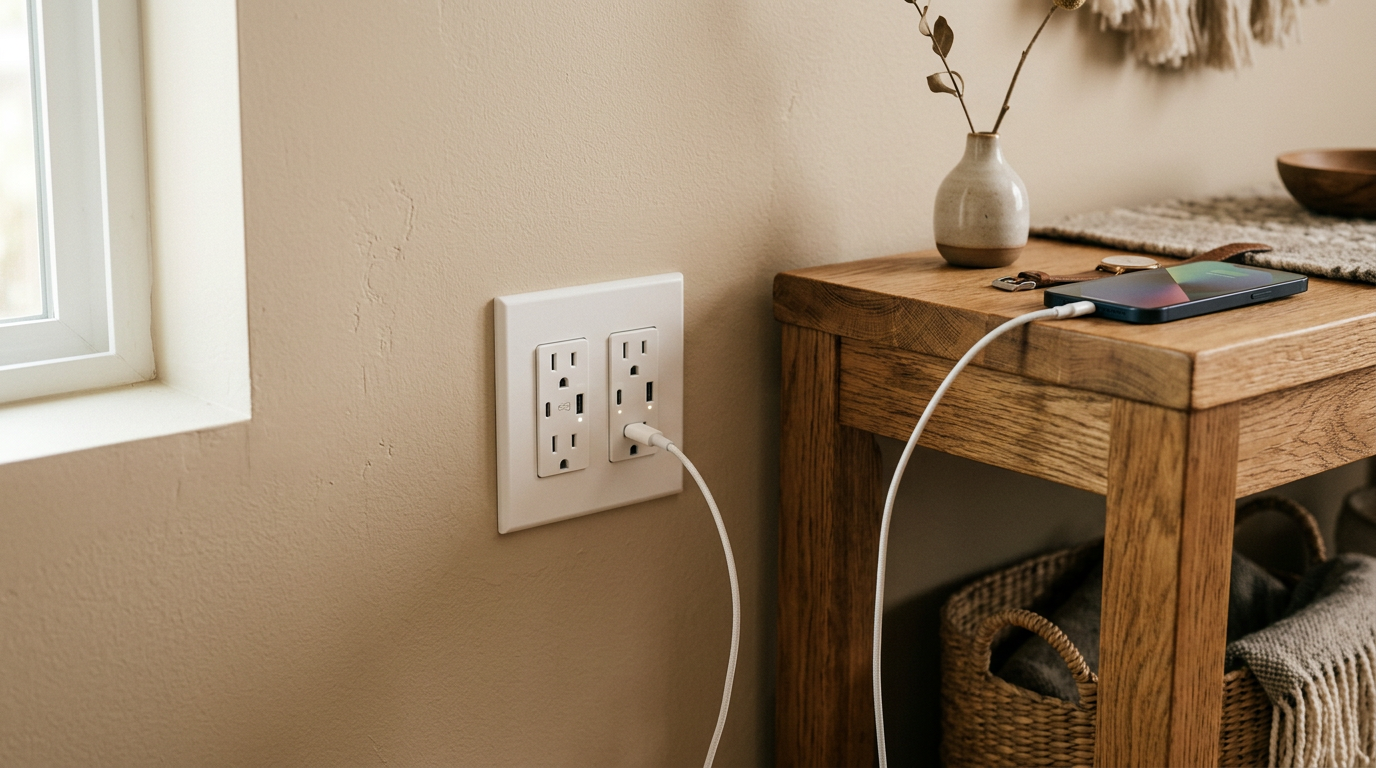
Instead of hunting for plastic charging blocks, you can install outlets with built-in USB ports. Look for combinations that offer both USB-A (the older, rectangular plug) and USB-C (the newer, smaller oval plug).
- Where to put them: Next to the bed, in the home office, drop zones near the entryway, and at the kitchen island.
- Pro Tip: Make sure to select outlets with high-wattage charging capabilities, which allow you to charge tablets and laptops directly from the wall without a brick.
Smart Outlets
Smart outlets connect to your home Wi-Fi network, allowing you to control whatever is plugged into them via a smartphone app or voice assistant. You can set schedules for lamps, monitor energy usage, or turn off a curling iron from your office at work.
While plug-in smart adapters work fine, in-wall smart receptacles keep your walls looking clean and uncluttered.
Floor Outlets
If your living room has an open-concept layout where the couch sits in the middle of the room, you should install a floor outlet under the seating area. This allows you to power end-table lamps, charge your phone on the side table, or power a reclining sofa without running trip-hazard cords across the walk paths.
Floor outlets feature brass or nickel covers that sit flush with your hardwood or carpet when not in use.
Pop-Up Counter Outlets
Kitchen islands often have beautiful waterfall countertops or decorative side panels where a standard wall outlet would look out of place. Pop-up counter outlets sit flush inside the countertop.
With a simple press, they rise up to reveal outlets and USB ports, then slide back down when you are finished cooking.
       [ Closed Flush Draft ]             [ Active Pop-Up Position ]
       +--------------------+                    +----------+
       |   Kitchen Island   |                    | [ o  o ] | <-- Outlets
=======|====================|=======      =======| [ o  o ] |=======
       |                    |                    | [======] | <-- USB Ports
       +--------------------+                    +----------+
Dedicated 20-Amp Circuits
Standard household lighting and outlet circuits are 15 amps. However, high-heat appliances can easily trip these circuits. When planning your layout, consider asking your contractor for dedicated 20-amp circuits in these specific locations:
- The Espresso Bar: High-end espresso machines and grinders pull significant power.
- The Master Bath: High-wattage hair dryers, straighteners, and bidet seats perform better on dedicated lines.
- The Workshop or Garage: Table saws, air compressors, and dust collectors need their own dedicated power supply.
High-Voltage Outlets (240V)
If you want to future-proof your utility spaces, run a 240-volt circuit. In the garage, a dedicated 50-amp, 240V circuit utilizing a NEMA 14-50 outlet is the standard for Level 2 EV charging, allowing you to charge an electric vehicle overnight.
Likewise, a dedicated 240V run to your back patio can prepare your home for a hot tub, or power high-performance woodworking equipment in your basement shop.
Designing Your Electrical Plan
Getting your electrical plan right requires a mix of foresight and professional guidance. When we walk through a home with our clients, we look at how they live, where they sit, and how they work. Getting those outlets exactly where you need them transitions a home from simply functional to truly comfortable.
If you are planning a remodeling project or an addition and want to make sure your home’s infrastructure is safe, modern, and convenient, we are here to help. Reach out to the team at Modern Builders of America for a free in-home estimate at /contact, and we will help you design a space that works beautifully for your lifestyle.