Choosing the right wood flooring is one of the most significant design and financial decisions you will make for your home. The right choice anchors your interior design, withstands decades of daily foot traffic, and adds genuine equity to your property. However, navigating the differences between solid wood, engineered planks, wood species, and finish types can quickly feel overwhelming.
This guide breaks down the essential choices in residential wood flooring, stripping away the marketing jargon to help you select the best surface for your family’s lifestyle, budget, and home architecture.
Solid vs. Engineered vs. Reclaimed: The Core Differences
Before choosing a wood species or paint color, you must choose how your flooring is constructed. The three primary categories of real wood flooring are solid hardwood, engineered hardwood, and reclaimed wood.
Solid Hardwood
Solid hardwood is exactly what it sounds like: a single, continuous piece of wood milled from a tree, typically 3/4-inch thick.
- Longevity: Because it is solid wood all the way through, it can be sanded and refinished many times—often five to seven times over its lifespan. A well-maintained solid hardwood floor can easily last a century.
- Climate Sensitivity: Wood is hygroscopic, meaning it absorbs and releases moisture. Solid wood planks swap moisture with the air, expanding in humid summers and contracting in dry winters. This can lead to cupping, gapping, or squeaking if the climate inside your home fluctuates wildly.
- Best Placement: Solid hardwood is best installed on or above-grade (ground level or higher) and over a wood subfloor. It should not be installed directly over concrete slabs or in basements, where moisture levels are too high.
Engineered Hardwood
Engineered hardwood is real wood, but it is built in layers. It features a top layer of real hardwood (called the wear layer) bonded over a core of high-grade plywood or high-density fiberboard (HDF) arranged in cross-directional layers.
- Dimensional Stability: The cross-grain construction of the core prevents the wood from expanding and contracting as much as solid wood. This makes engineered wood highly stable.
- Placement Versatility: Engineered flooring works beautifully over concrete subfloors, over radiant heating systems, and even in finished basements where solid wood would fail.
- Refinishing Potential: How many times you can sand and refinish an engineered floor depends entirely on the thickness of the wear layer. A cheap engineered floor with a 1mm wear layer cannot be sanded at all. A premium plank with a 4mm to 6mm wear layer can be refinished three or four times, giving it a lifespan that rivals solid wood.
Reclaimed Wood
Reclaimed wood is salvaged from old barns, factories, warehouses, or historical residential structures.
- Character and History: These planks carry a unique patina, featuring original saw marks, nail holes, weathering, and tight grain patterns from old-growth timber that you simply cannot find in newly harvested wood.
- Sustainability: Reclaimed wood is an incredibly eco-friendly choice, as it repurposes existing lumber rather than harvesting new trees.
- Cost and Prep: Because of the labor involved in sourcing, de-nailing, kiln-drying, and milling irregular antique wood, reclaimed flooring is typically the most expensive option. Your installer may also need to do extra prep work to handle slight variations in plank thickness.
| Flooring Type | Average Wear Layer / Thickness | Ideal Location | Refinishing Potential | Stability |
|---|---|---|---|---|
| Solid Hardwood | 3/4" solid wood | On or above grade | 5 to 7 times | Moderate |
| Engineered Wood | 2mm to 6mm wear layer | Anywhere, including basements | 1 to 4 times | High |
| Reclaimed Wood | Varies (often solid 3/4") | On or above grade (typically) | Varies by wear layer | Low to Moderate |
Choosing a Wood Species: Hardness, Grain, and Value
Different wood species offer different levels of durability, grain patterns, and natural coloration. To compare their hardness, we refer to the Janka Hardness Scale, which measures the force required to embed a small steel ball halfway into the wood.
White Oak (Janka: 1360)
White oak is the undisputed darling of modern home design. It is highly durable, water-resistant relative to other woods, and has a linear, elegant grain pattern. Its neutral, wheat-colored undertone accepts gray, white, and brown stains beautifully without turning pink.
Red Oak (Janka: 1290)
Slightly softer than white oak, red oak features a more dramatic, swirling grain pattern. Its natural reddish-pink undertones make it a warmer choice, though it can be trickier to stain if you want to eliminate those red tones. Red oak is highly abundant and is typically one of the most budget-friendly hardwood options.
Hickory (Janka: 1820)
If you have large dogs, busy kids, or high foot traffic, hickory is an exceptional choice. It is incredibly hard and features dramatic color variations between its pale sapwood and dark heartwood. Its busy grain pattern is excellent at hiding scratches, dents, and dirt.
Walnut (Janka: 1010)
Walnut is a softer wood, meaning it will dent more easily under heavy impact. However, many homeowners willingly trade durability for its unparalleled beauty. Walnut features rich, deep chocolate-brown tones and a luxurious, swirling grain. It is premium, sophisticated, and sits at the higher end of the pricing spectrum.
Maple (Janka: 1450)
Hard maple is exceptionally durable and features a clean, uniform, and light look with very subtle grain lines. It is ideal for minimalist, modern, or Scandinavian designs. However, maple has dense, closed pores, which make it notoriously difficult to stain evenly; it is best finished in its natural light state.
Ash (Janka: 1320)
Ash has a hardness similar to white oak, with a bold, ringing grain pattern similar to oak but with a lighter, creamy color palette. Unfortunately, due to the emerald ash borer beetle, ash lumber has become scarcer and more expensive in recent years, though it remains a stunning, airy choice for modern homes.
Finishing Touches: Factory-Finished vs. On-Site and Oil vs. Poly
The way your floor is finished determines not only how it looks on moving-day, but how it wears over the next fifteen years.
Site-Finished vs. Prefinished Planks
You have two choices for when and where the protective finish is applied:
- Prefinished (Factory-Finished): The wood is stained and sealed in a controlled factory environment. It arrives at your home ready to walk on, and the finish is incredibly tough because it is cured under UV lights. The downside is that prefinished planks usually have micro-beveled edges, creating tiny "V-grooves" between planks that can catch dust.
- Site-Finished: Raw wood is installed, sanded flat, stained, and sealed inside your home. This process is dusty and requires you to leave the home for several days while the finishes cure. However, it results in a perfectly flat, monolithic floor with no micro-bevels, which many homeowners prefer for its seamless look and easier cleaning.
Oil vs. Polyurethane
This choice dictates how you will maintain your floor over its lifetime.
- Polyurethane (Water-Based or Oil-Based): Polyurethane acts as a plastic-like protective shield sitting on top of the wood. It is excellent at resisting spills and scratches. However, when it does scratch or wear through, you cannot easily spot-repair it; you must sand down and refinish the entire room.
- Penetrating Oil: Oil finishes sink deep into the wood fibers, hardening them from within. It leaves a incredibly natural, low-lustre look where you feel the actual grain of the wood, not a plastic barrier. While oil finishes scratch more easily, they are incredibly simple to spot-repair. You can buff a dab of maintenance oil directly into a scratch with a rag, and it disappears.
Matte vs. Satin Sheen
The trend in home design has moved decisively away from high-gloss finishes, which reflect too much light and highlight every speck of dust, pet hair, and scratch.
- Matte (10% to 20% sheen): Gives the wood a dry, natural, raw appearance. It is exceptional at hiding wear and tear.
- Satin (30% to 40% sheen): Offers just enough luster to reflect soft light and highlight the wood's grain, while remaining forgiving enough to hide minor daily debris.
Current Design Trend: Wide Planks
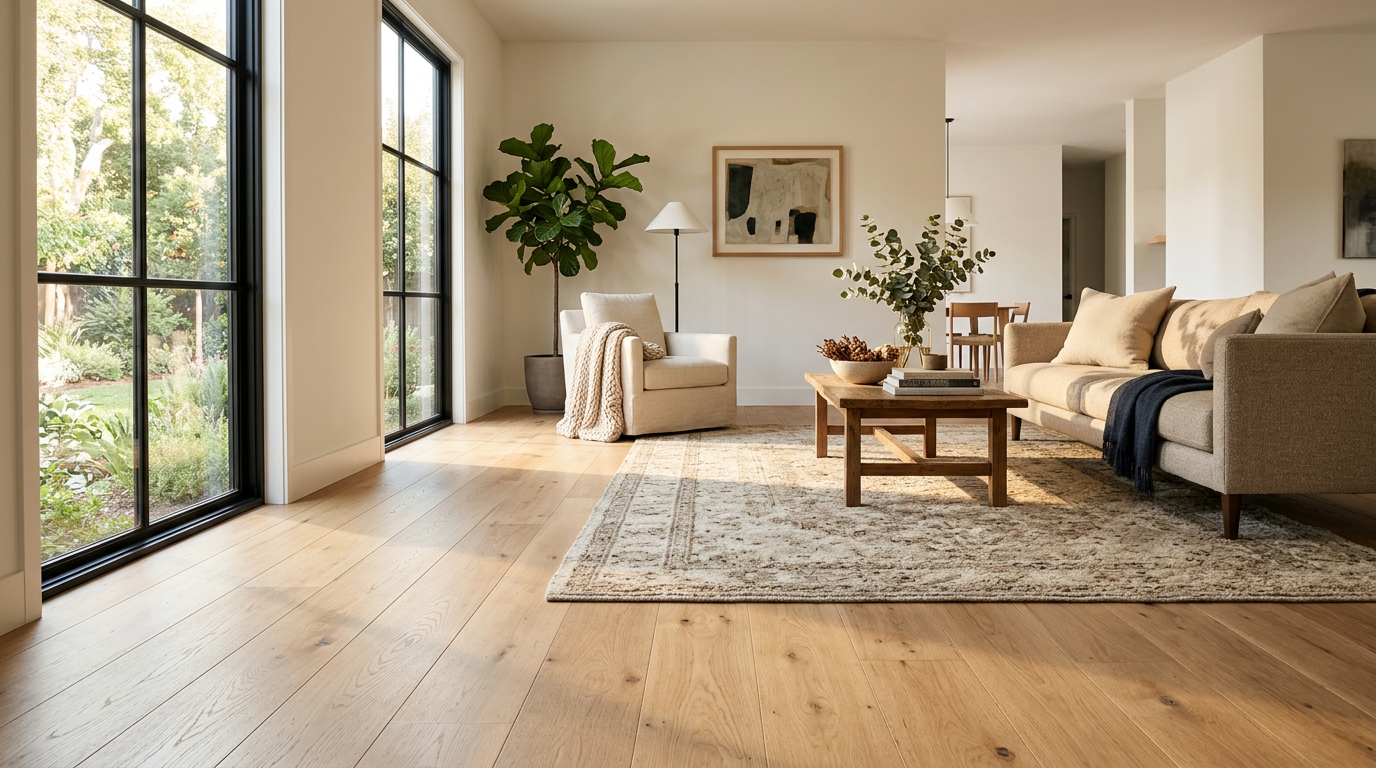
For decades, the standard strip hardwood floor was 2-1/4 inches wide. Today, modern trends lean heavily toward wider planks—specifically 7 inches wide and up.
Wide planks create fewer seams across a room, which visually opens up a space and makes it feel calmer and more expansive. However, wide planks also show off more of the wood's natural grain and character.
If you choose wide planks, we highly recommend opting for engineered construction. Wide solid wood planks are much more prone to cupping and gapping because of the sheer volume of wood fiber expanding and contracting across each individual board. An engineered construction keeps these wide boards perfectly flat and stable year-round.
Common Hardwood Myths Debunked
Myth 1: "Engineered hardwood is fake or cheap laminate."
This is the most common misconception. Laminate flooring is a photographic image of wood printed onto a fiberboard core with a plastic protective layer. Engineered hardwood, on the other hand, is 100% real wood. When you look at an installed engineered floor, you are looking at and walking on the exact same genuine wood species you would see on a solid plank.
Myth 2: "You can’t put hardwood in a kitchen."
With modern finishes, hardwood is a fantastic, soft-underfoot option for kitchens. It unites open-concept floor plans seamlessly. While you should not let standing water pool on wood, a high-quality polyurethane or oil finish will easily survive daily kitchen spills. We simply recommend placing a comfortable, breathable mat in front of the sink and dishwasher to catch rogue splashes.
Selecting the perfect wood floor is a balancing act between the architectural style of your home, your family’s daily habits, and your long-term budget. If you are ready to explore sample boards in your own light and talk through the best installation methods for your home's unique layout, we would love to help. Please reach out to Modern Builders of America to schedule a free in-home estimate with one of our flooring experts.